Overview addressed philosophical problems
by Marinus Jan Marijs
On the road to eternity, no one traveled further than the mystics. While their influence on society has been tremendous, what mysticism and spiritual transformation are, is veiled in obscurity. Many descriptions of the mystical experience are cryptic, use parables, analogy and symbols, which have a metaphorical meaning.
The aim of this website is to give detailed phenomenological descriptions of the different mystical experiences, the energies behind them, the different stages and the processes that are involved in it. This website gives a conceptual framework which describes different mystical experiences, how they are related to each other, and how they transform individuals and society. Where possible it has been attempted to support the different theories by evidence. To find supporting evidence, cross cultural data and quantifiable data has been collected. Metaphorical, poetic or symbolic descriptions are replaced by clear technical language which can only be interpreted in one way. Furthermore artistic or symbolical drawings of the subtle energy systems are replaced with technical drawings.
And to find a way to describe the indescribable.
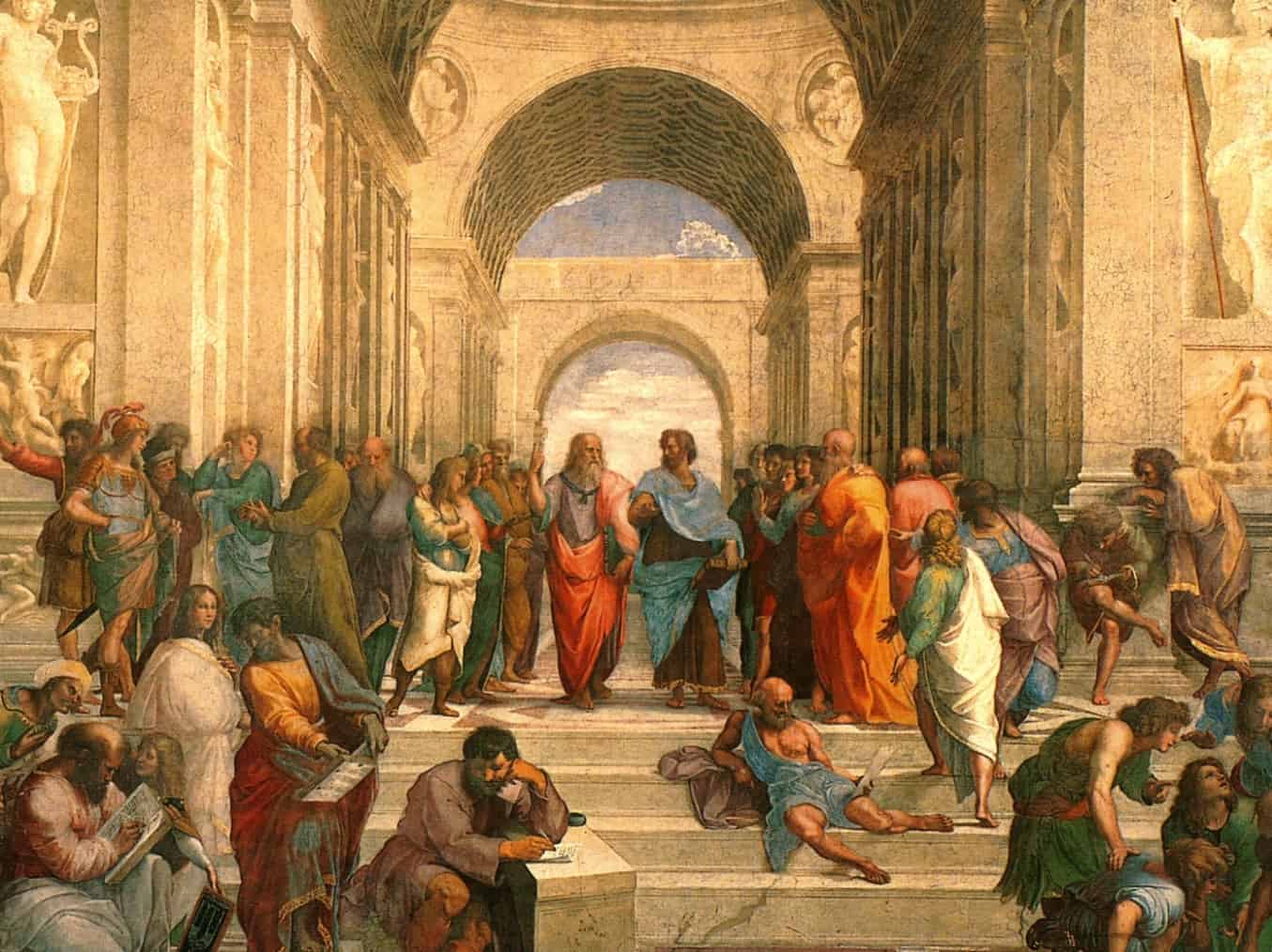
Raphael (1483 – 1520) The School of Athens
Philosophical problems addressed on this website
In this website a great number of (classical) philosophical problems are addressed and solutions are proposed and put forward. A list of the addressed philosophical problems is given below:
- Descartes mind-body problem. The relationship of the mind to the body;
Click here for more details - Leibniz’s question: ‘Why is there something instead of nothing?’
Click here for more details
- Locke’s primary and secondary qualities distinction. The origin of secondary qualities.
Click here for more details
- Kroeber’s configurations of cultural growth. Is there a cyclical process within cultural development?
Click here for more details
- Wilber’s Pre-Trans theory. Is mysticism pre or trans-logical.
Click here for more details
- Howard Gardner’s multiple intelligences. Multiple individual developmental sequences.
Click here for more details
- Teilhard de Chardin’s Omegapoint. What is the Omegapoint.
Click here for more details
- Aurobindo’s Supramentalisation. How does this process takes place.
Click here for more details
- The James – Lange emotion theory. Why emotions are associated with specific parts of the body.
Click here for more details
- The complexity – ontology problem. The relations between complexity and ontology.
Click here for more details
- Plato’s; the good, the beautiful and the true. What are the major domains of reality?
Click here for more details
- The transformation problem. What are the processes underlying the transformations from one level to another.
Click here for more details
- The eschatological question. What is the ultimate destiny of humanity and the Kosmos?
Click here for more details
- Buddha’s concept of Nirvana. What is nirvana?
Click here for more details
- Poortman’s problem. The history, the meaning and the truth of hylic pluralism.
Click here for more details
- The Atman = Brahman problem. How can the many be the same as the one without a second?
Click here for more details
- The consciousness problem. What is consciousness?
Click here for more details
- What is the meaning of life?
Click here for more details
- Aristotle’s teleology. The purpose of an immanent final cause.
Click here for more details
- Karl Jasper’s Axial period. Similarly revolutionary thinking in China, Ancient Greece, India and the Middle East.
Click here for more details
- The super-string. What is the geometry of the super-string?
Click here for more details
- Levels of perception. What are the forms of perception on different ontological levels?
Click here for more details
- Classical composers. What is the source of their inspiration?
Click here for more details
- The moral problem of violence. Pacifism.
Click here for more details
- The Krishnamurti-Bohm problem. What is the smallest number of enlightened human beings whose collective influence can initiate a transformation in global consciousness?
Click here for more details
- Schrodinger’s entropy. In a world governed by the second law of thermodynamics, all isolated systems are expected to approach a state of maximum disorder. Since life approaches and maintains a highly ordered state – some argue that this seems to violate the aforementioned Second Law implying a paradox.
Click here for more details
- Platonic theory of forms; about forms that exist not in objects in the world but in a transcendental realm.
Click here for more details
- Non-causality: the experience of two or more events as meaningful related, where they are not causal related
Click here for more details
- Cosmological fine-tuning. The fine-tuned Universe is the proposition that the conditions that allow life in the Universe can only occur when certain universal fundamental physical constants lie within a very narrow range, so that if any of several fundamental constants were only slightly different, the Universe would be unlikely to be conducive to the establishment and development of matter, astronomical structures, elemental diversity, or life as it is understood. The proposition is discussed among philosophers, scientists, theologians.
Click here for more details
- Akashic records (Kosmic memory).
Click here for more details
- Transcending of space and time.
Click here for more details
- Anthropic principle: In astrophysics and cosmology, the anthropic principle (from Greek anthropos, meaning “human”) is the philosophical consideration that observations of the physical Universe must be compatible with the conscious life that observes it. Some proponents of the anthropic principle reason that it explains why the Universe has the age and the fundamental physical constants necessary to accommodate conscious life. (Wikipedia)
Click here for more details - Complexity of biological systems. Whether there is an explanation for the extraordinary complexity of biological systems.
Click here for more details
- Archetypes, Transcendental structuring patterns.
Click here for more details - The difference between the physical Cosmos and the ontological multilevel (Pythagorean) Kosmos.
Click here for more details - What is spiritual enlightenment?
Click here for more details - Life after death.
Click here for more details - Memory.
Click here for more details - Non-locality: The concept of Non-locality in different academic disciplines.
Click here for more details - Creative processes and inspiration.
Click here for more details - Collective developmental sequences.
Click here for more details - Mathematics and the structure of reality. The enormous usefulness of mathematics in the natural sciences is something bordering on the mysterious and that there is no rational explanation for it.
Click here for more details - Theodicy the question, why a good God permits evil.
Click here for more details - Shankara’s problem: is the ultimate experience theistic or non-dual. See 3 forms of mysticism.
Click here for more details - The concept of a soul.
Click here for more details - Arguments related to the existence of a transcendent intelligent Kosmic force, usually identified as God.
Click here for more details - The nature of the Absolute.
Click here for more details - How many talents, forms of genius, spiritual powers, siddhis, charismata there are, and what are they.
Click here for more details - William James’ question: What are the varieties of mystical experiences.
Click here for more details - What is intuition.
Click here for more details - What are the higher levels of consciousness.
Click here for more details - What are the different collective (social / cultural) development lines.
Click here for more details - Involution.
Click here for more details - Different organizational structures / systems.
Click here for more details - Non-local perception.
Click here for more details - A fractal process in time (1/4 process).
Click here for more details - What is the structure of the subconsciousness.
Click here for more details - The transformation of society.
Click here for more details - How are the different dimensions of the Kosmos connected. See cross-connections, Octagon.
Click here for more details - Which phenomena cannot be explained in naturalistic / physical terms. See openingpage of this website.
- How many different forms of samadhi are there?
Click here for more details - The concept of a transcendent kosmic force.
Click here for more details
- Is it possible to qualify the capacity of human intuition compared to analytical / algorithmic processes?
Click here for more details -
Does free will exist?
Click here for more details - What are qualia?
Click here for more details - What are the philosophical implications of the Big Bang?
Click here for more details -
Are there other / higher levels of existence?
Click here for more details - How are the different corners of reality interrelated?
Click here for more details - Why do humans decide to reincarnate?
Click here for more details
See within this page on: number 106 -
The nature of consciousness.
Click here for more details
71. Supporting historical evidence for the existence of the biblical covenants of Judaism and christianity.
https://marinusjanmarijs.nl/archetypical-stories/old-testament/
Click within this page on: The covenant
Cross-Cultural research (40x)
Omega point 20 cultures
Messiah 21 cultures
Axial period 4 cultures
Kundalini (concept) 8 cultures
Kundalini (Iconography) 16 cultures
425 year process 370 mystics
Non-physical worlds 5 cultures
Composers 10x
Music of the spheres 6 cultures
Shaktipat 7cultures
Menora 2 cultures
Chakra’s 6 cultures
Subtle energies 101 cultures
Rainbow body 8 +10 cultures
God-Godhead—-
Five mystical levels 7 cultures
Pacifism 12x
Influence of mystics on society 18 cultures
Poetry 14x
Moralists —-
Founders of religion 9 cultures
Philosophers —-
Enlightenment 13x cultures
Socianic God (Evolutionary) 5 cultures
Life after death 6 cultures
O.B.E. classics 11 cultures
Trinity 5 cultures
Levels of existence and human aspects 7 cultures
Silver cord 32 cultures
Non-locality 6 academic disciplines
Parallel discoveries —-
Siddhi’s —-
Tree of live 10 cultures
Paradise myth —-
Deva’s, angels —-
Meaning of aura colours 5 cultures
Apotheosis —-
Forms of talent—-
Crime statistics—-
Forms of genius—-
Quantification (10x)
Time constant 4,7 seconds
Time constant 425 years
¼ process
Field volume: 2,3 diameter, volume 12x
Axial period synchronicity
5 main groups
12 ontological levels
Octagon 8 corners
Lateral development 4 phases
Research Area’s
Show some love
"A philosophical treatise can be mostly written in object or process language,
but phenomenological descriptions must be by its very nature first person descriptions.
It is for this reason that self-observations, and personal experiences of the author are included."
Marinus Jan Marijs.