The mind body problem
by Marinus Jan Marijs
One of the classical problems of philosophy is the mind-body problem. Brought forward by Descartes, it has been referred to as the major philosophical problem. Descartes’ problem has to do with the dualism of body and soul. If a human has a soul, how is it connected with the physical body? In more modern language: How does the mind interact with physical matter (in particular the physical body)?
Sir Charles Sherrington, who received the Nobel Prize for his research on the nervous system, referred to this problem in the following terms: “We have to regard the relation of mind to brain as still not merely unsolved, but still devoid of a basis for its very beginning”. This statement, pronounced decades ago, still reflects the opinion of many philosophers.
The mind-body problem is also called ‘the hard problem’, the ‘world knot’ or the ‘explanatory gap’.
There are of course other aspects to the mind-body problem. What is explained in the first paragraph is the connection of the subtle energies with the physical body. Another question is how consciousness and the physical body are related. That question will be answered in the second paragraph.
Subtle energies
The preposition here is that subtle energies and a sophisticated system of energy channels connect consciousness with the physical body.
Over the course of time, it has been noted in different cultures that the physical body is pervaded and enveloped by subtle energy fields.
These fields can be perceived visually and are called the auras. These subtle energy fields are responsible for the perceptions of light by mystics during their mystical experiences. There are hundreds of descriptions of such perceptions left behind by mystics.
The energy fields are compounded of different subtle aura fields that exist at different levels. They consist of non-physical energies, non-physical substances, and it is these that constitute the mind and the soul.
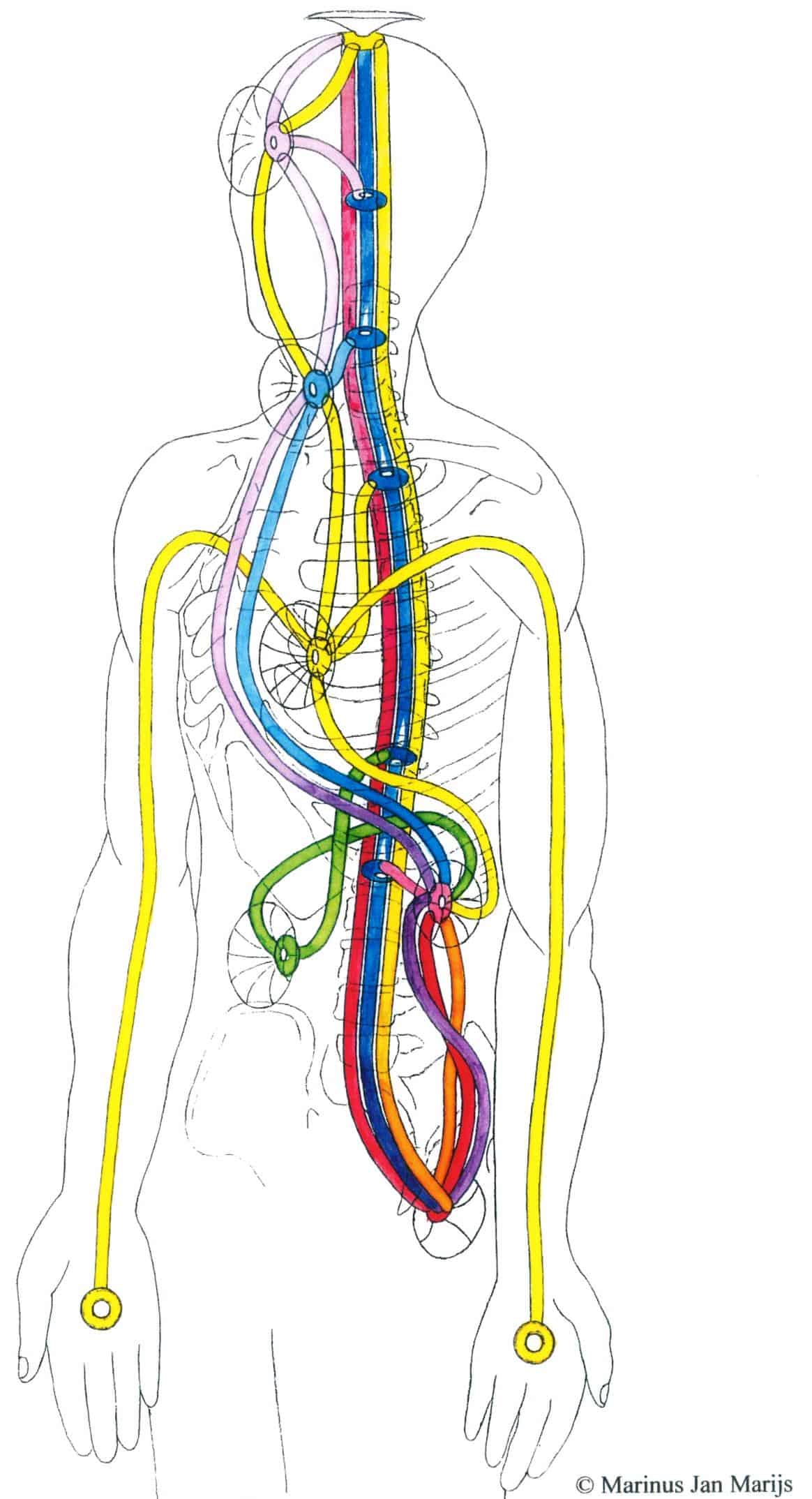
These subtle energies circulate in the chakras, and are subsequently drawn into the big nadis (non-physical energy channels) through the rings (granthi).
One of the most important rings is located at the higher brainstem (see figure 51 below). Its location corresponds with the results of research by neurosurgeon Wilder Penfield relating to the physical place where he claims that consciousness is switched on and off. [1]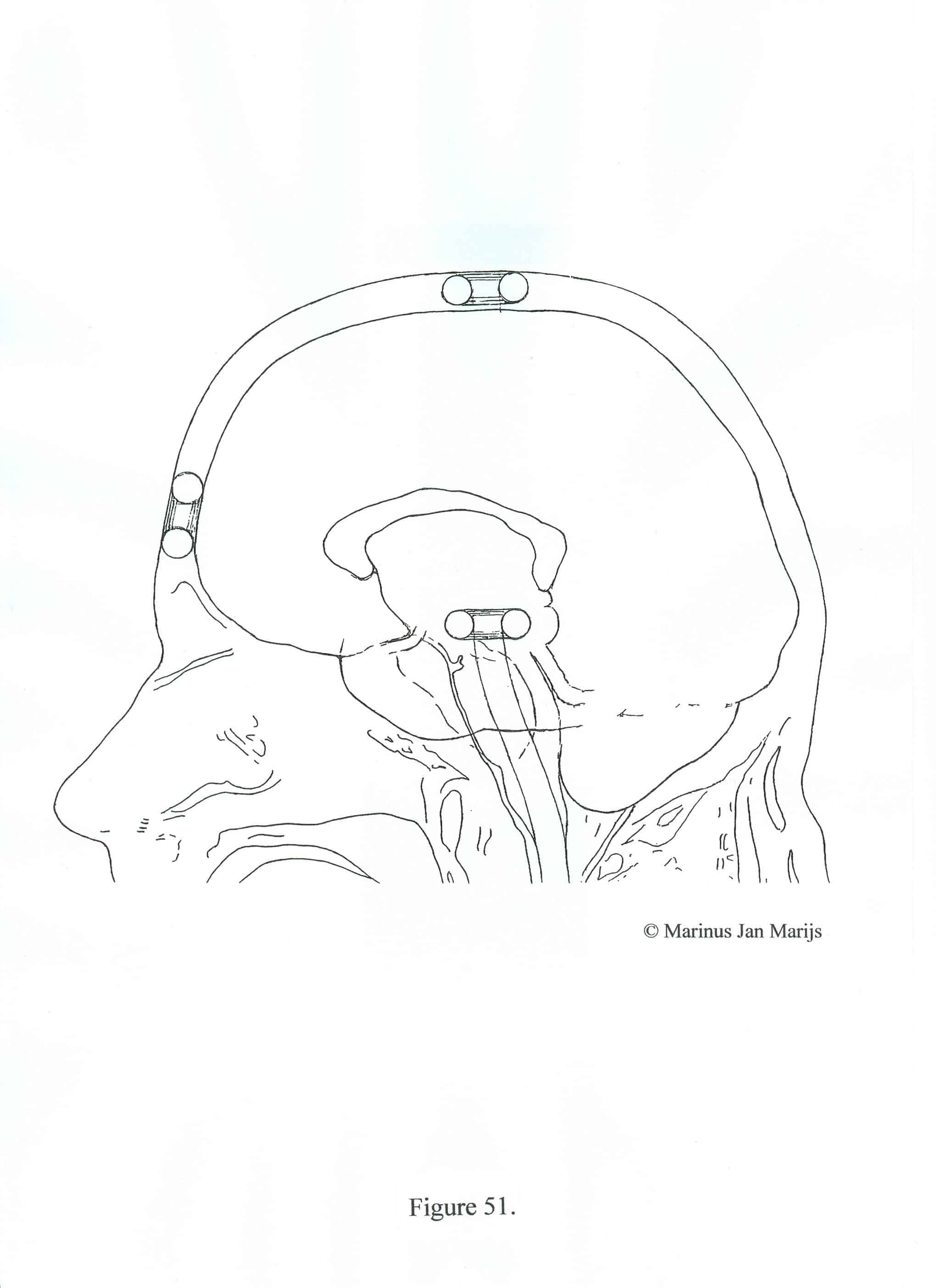 Small nadis originate from the three rings located in the head. These small nadis spread throughout the brain (see figures 41, 43, 44 and 45). They transport and distribute the subtle energies throughout the brain.
 Figure 41
 Figure 43
 Figure 44

How these subtle energies can affect the brain one can find in the publications of Nobel Prize winner and brain researcher John Eccles. [2],[3],[4],[5]
Eccles formulated the following question:
Since it is clear that telekinetic phenomena do exist (Eccles refers to a number investigations done in this area [6]), is it possible that the mind can exert influence on the synapses by telekinetic force?
Eccles writes [7] that the mass of a ‘synaptic unit’ is 0.000000000000000001 gram (10 -18 gram), and that, because of all the cross connections, the switching of one synaptic unit can cause a cascade of changes within the brain. Eccles’ opinion in this matter is important because he received the Nobel Prize for his research on the biophysical properties of synaptic transmission. Because of the extraordinarily small mass of these switch-elements in the brain, they could, according to Eccles, be pre-eminently suitable for interaction with a non-physical mind.
(The Hameroff – Penrose Orchestrated objective reduction (Orch-OR) hypothesis can be relevant here).
The text above describes the conscious interference of the mind/soul with the brain. The interaction between the brain and the non-physical mind/soul also becomes apparent when one considers any situation where an automatic process (such as driving a car on a familiar road) is interrupted by a sudden occurrence. This means that consciousness is at its height when the nerve processes are hesitant.
When a situation cannot be handled by automatisms, conscious interference takes place, and it is at this moment that the mind interacts with the synaptic units within the brain.
To sum up:
The mind/soul is composed of subtle energies which circulate in the chakras and are subsequently drawn into the big nadis through the rings (see figure 37).
Figure 37
 © Marinus Jan Marijs
These subtle energies are then transported and distributed throughout the brain by the small nadis, (see figures 41, 43, 44 and 45). These subtle energies interact with the ‘synaptic units’ in the brain.
So by connecting this knowledge of the subtle energy systems with the research done by Penfield and Eccles, the solution of the mind-body problem becomes clear.
Consciousness: Oneness and the levels of consciousness
Another question is how consciousness and the physical body are related. The Absolute as pure consciousness which is omnipresent, but through an individual focal point it can connect with subtle energies and can function within the relative world of time and space. Because there are different levels of consciousness, each with its own subtle energy, there can be an emotional consciousness, mental consciousness (mind) and a mystical consciousness.
Theoretical physicist and Nobel-laureate Erwin Schrödinger was one of the greatest physicists of the 20th century. In his books “What is life” (1944) and “My view of the world” (1964) he puts forward his thoughts about the nature of consciousness.
According to Schrödinger “consciousness is a singular of which the plural is unknown; that there is only one thing and that what seems to be a plurality is merely a series of different aspects of this one thing, produced by a deception.”
In his books he refers to the Upanishads insight: “Atman = Brahman means the personal self equals the omnipresent, all-comprehending eternal self”
To Schrödinger, consciousness is only One, singular and identifiable with its universal source: Brahman, the Absolute.
The statement that “consciousness is One, singular” is similar to Plotinus’s famous statement that “the Absolute is one without a second”.
The Absolute transcends space and time, being timeless, spaceless. Albert Einstein made the following, remarkable statement directly addressing this point:
“For us convinced physicists, the distinction between past, present and future is only a stubbornly persistent illusion. … . Time is not at all what it seems. It does not flow in only one direction, and the future exists simultaneously with the past” (Einstein) [8].
And: “A human being is part of the whole, called by us “Universe”; a part limited in time and space. He experiences himself his thoughts and feelings …as something separated from the rest- a kind of optical delusion of his consciousness” (Einstein) [9].
Here the simultaneousness of past and future and the non-separateness, the eternal now and the oneness refer to the Absolute which transcends time and space as Ultimate Reality.
The ideas relating to consciousness, put forward by Schrödinger, are in sharp contrast with the generally held belief in the Western world that the brain generates consciousness and that consciousness is an epiphenomenon (‘secondary phenomenon which results from another’) of brain activity.
As Schrödinger indicated, this point of view relating to consciousness has already been described by many mystics throughout the centuries.
He calls it “the greatest of thoughts”. In his book “What is life”, 1944.
Within mystical experiences, be it nature mysticism or higher forms of mysticism, there is an union with higher levels of existence.
In these mystical experiences the surrounding world is experienced as intensely alive. For the mystic it becomes clear that the non-physical energies which penetrate the Kosmos are not only alive but are also conscious.
Richard Bucke, who did a classic study on this subject, described it with the term “cosmic consciousness” which is the title of his book. Krishnamurti, in his dialogue with theoretical physicist David Bohm, says that consciousness comes from a (cosmic) ‘ground’, which includes the whole universe. Central to his philosophy was the idea that if 5 to 10 people would become ‘enlightened’ or undergo a total transformation, the whole of humanity would change because consciousness according to Krishnamurti is non-locally united in an indivisible whole.
The Upanishads speak of ‘Atman = Brahman’. Christ referred to his indivisible whole in his statement that “the Father and I are one”. Edward Carpenter, a leading philosopher in late 19th- and early 20th-century Britain, describes it as follows: “This consciousness is the feeling that oneself is all these objects, things and persons and the whole universe”
The realization that the Absolute and pure consciousness are identical becomes clear when one is in turiya (‘state of being in which a person is one with the Absolute’). During the night, the body falls asleep, but one stays fully conscious 24 hours a day.
How can Brahman, which is one without a second, be identical to the many Atman’s? Brahman has been described as a circle of which its center is everywhere and its circumference nowhere. The Absolute is a point so to speak that transcends space and time. This point is present simultaneously everywhere and anytime. This means that the Absolute is present within every point in space and time simultaneously. There are no multiple space-time coordinates here so the Absolute is One without a second.
Because the Atman is a point within space and time, there can be many Atman’s. Because Brahman as a point is present everywhere, this point coincides with all points (atman’s) that reside within space and time. Therefore Brahman and Atman’s are One.
Consciousness and levels of consciousness
The question one could ask is when consciousness is One, how can there be different levels of consciousness? That there are different levels of consciousness becomes apparent within academic research of developmental sequences related to psychological development. This is related to the existence of different levels of subtle energies. When subtle energies at a certain level are activated, then it becomes possible to be conscious at this level. For every level of consciousness there is a level of corresponding subtle energies.
In other words:
The Kosmos has a layered structure which has a ‘background’ which is present at all levels, but is in itself not a level.
If on one of the levels subtle energies are activated and are in contact with the background then this creates consciousness at that level.
As there are different subtle energies on different levels, they generate different kinds of consciousness according as higher fields of subtle energies are activated at higher levels.
Eugene Paul Wigner states in “Remarks on the mind body question”:
“Until not many years ago, the existence of a mind or soul would have been passionately denied by most physical scientists. The brilliant successes of mechanistic and, more generally, macroscopic physics and of chemistry overshadowed the obvious fact that thoughts, desires, and emotions are not made of matter, and it was nearly universally accepted among physical scientists that there is nothing beside matter. The epistome of this belief was the conviction that, if we knew the positions and velocities of all atoms at one instant of time, we could compute the fate of the universe for all future” Even today, there are adherents to this view though fewer among the physicists than — ironically enough — among biochemists.
There are several reasons for the return, on the part of most physical scientists, to the spirit of Descartes’s “Cogito ergo sum,” which recognizes the thought, that is, the mind, as primary. First, the brilliant successes of mechanics not only faded into the past; they were also recognised as partial successes, relating to a narrow range of phenomena, all in the macroscopic domain. When the province of physical theory was extended to encompass microscopic phenomena, through the creation of quantum mechanics, the concept of consciousness came to the fore again: it was not possible to formulate the laws of quantum mechanics in a fully consistent way without reference to the consciousness.
All that quantum mechanics purports to provide are probability connections between subsequent impressions (also called “apperceptions”) of the consciousness, and even though the dividing line between the observer, whose consciousness is being affected, and the observed physical object can be shifted towards the one or the other to a considerable degree, it cannot be eliminated. It may be premature to believe that the present philosophy of quantum mechanics will remain a permanent feature of future physical theories; it will remain remarkable, in whatever way our future concepts may develop, that the very study of the external world led to the conclusion that the content of the consciousness is an ultimate reality.
(“Remarks on the Mind-Body Question,” in Symmetries and Reflections, p.171)
[1] Wilder Penfield; “The mystery of the mind”, Princeton University Press Princeton, New Jersey, 1975.
[2]: John C. Eccles; “The neurophysiological basis of mind”, 1953.
[3]: John C. Eccles; ”Facing Reality”, 1970.
[4]: Karl R. Popper and John C. Eccles; “The self and its brain”, 1977.
[5]: John C. Eccles; ”The Human Psyche”, 1980.
[6] John C. Eccles; “Hypotheses relating to the brain-mind problem”, article in Nature – July 14, 1951, vol. 168.
[7]: John C. Eccles; “A unitary hypothesis of mind-brain interaction in the cerebral cortex”, proceedings of the Royal Society of London – 1990, vol. 240 p. 433 – 451.
[8]: Marey Midley; ”The myths we live”, 2003.
[9]: Quoted in H. Eves; ‘Mathematical circles’, Adieu, Boston 1977.
Show some love
"A philosophical treatise can be mostly written in object or process language,
but phenomenological descriptions must be by its very nature first person descriptions.
It is for this reason that self-observations, and personal experiences of the author are included."
Marinus Jan Marijs.