Transformation and subtle energies
by Marinus Jan Marijs
Within the academic world there is a general agreement that in human development several different developmental lines can be distinguished. These can be divided in two broad categories, namely developmental lines at the individual level and at the collective level. Examples of the first category have been represented here . These include aesthetic-, cognitive-, interpersonal-, moral-, and spiritual developmental lines. Examples of the second category are worldviews and social systems.
Within human development, individual as well as in historical development, certain steps, stages and transitions can be observed. These processes of growth take place in a developmental sequence by which stratified levels within hierarchical systems are activated, one after (and above) another.
Looking at the individual developmental lines, developmental psychology shows that these different lines have a developmental sequence. During maturation higher developmental sequences are reached, step by step, towards higher waves of inclusion and transcendence to new possibilities, new capacities and the emergence of higher potentials.
In: “A conversation with Noam Chomsky and Howard Gardner;
Harvard Education 31.53 → 32.28.”:
Chomsky: ….“Piaget’s work was extremely important in recognizing that the children went through stages of conceptual development, and these were not simply the results of training, that they were somehow coming from somewhere else. That’s when you looked at the somewhere else, that it became pretty mystical and there was no mechanism in Piaget for any of these stages to develop or for the transition to take place”.
It is clear that these lines with their developmental stages are academically demonstrated, however it seems to be a total mystery why these levels do appear and why these transitions or transformations from level to level do occur. The American philosopher Ken Wilber talks about this problem in an online interview [1]
“Q: There is obviously plenty of evidence to suggest that stages of development provide an accurate conceptual snapshot of something that is actually happening in the real world. I think you call it (like) Kosmic habits laid down by previous evolution? Do we know that there are stages of development, I am not convinced that developmental holarchies provide a skillful means for actually showing people how to evolve into high stages. So I think the really important question isn’t really demonstrating that there are high stages, but how do we growth through the stages?
Ken Wilber: People like Kohlberg and Loevinger spent an awful lot of time trying to figure out just what is it that help people move from one stage to another, and you know the really (kind of) surprising, disappointing answer is: “We don’t know”. …. There are certain aspects, certain things that do seem to help, but they are not guaranteed. And it just reminds me again and again when you look at this research just how mysterious the whole process of transformation is.” (21:44 – 22:51 min.)
“Q: Is there any reliable evidence on the dynamics of transformation and the form of development? Are there any invariable patterns that connect across different stages and map out the actual process of transformation from one level to the next?
Ken Wilber: And the answer there again is, it’s because we don’t know actually what causes somebody to transform, we don’t know what the stable patterns of that are. But we can state just abstract things that are common across stages, but they are just abstract forms and not the “how to” and those abstract forms are for example fulcrums.” (27:50 – 28:25 min.)
In reaction to the problem talked about by Ken Wilber, the solution presented here concerns the existence of a stratification of ontological levels, each with a different kind of non-physical subtle energy.
In concordance with the (hierarchical) psychological development of a human being, the activation of the levels of subtle energy follows a (hierarchical) developmental sequence as well. The subtle energies levels develop from the lowest level of low astral energies, to the next level of high astral energies all the way up to the highest level of high causal energies. With every level the energy-potentiality of the subtle energies presented at that level increases a manifold, because they are active on distinctly different and higher ontological levels. To be able to activate a higher subtle energy level, the energy of a lower level has to build up in activity and intensity (lateral/horizontal growth) up to a certain threshold-point, after which the energy of the next higher level can be activated. This process repeats itself and moves up the gravitational center of a person.
This leads to the conclusion that the vertical activation of subtle energies is related to the term ‘transformation’, where as the horizontal/lateral growth of subtle energies is related to the term ‘translation’.
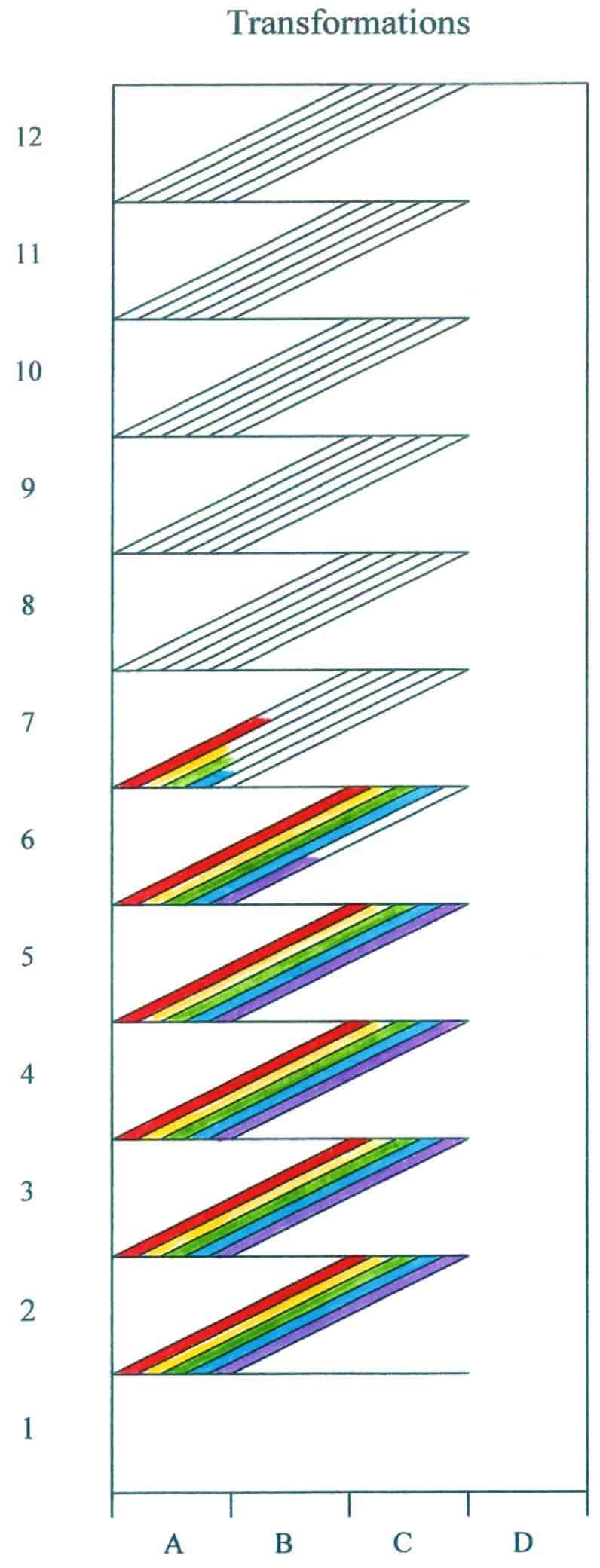
Before giving a concrete example, the relation between developmental lines and different subtle energy groups has to be presented. When one observes subtle energies, it is clearly visible that only five distinct groups of subtle energies are available at the five mystical levels. However, these five distinct groups are also present at the lower levels of human development. The development of the five subtle energy groups starts at the second level (‘emotional level’), also called the astral level, and proceeds level by level up to the high-causal level. Each of the five main groups stands on its own and are not reducible to each other.
These five subtle energy groups form the basic subtle energy ‘streams’ through which the developmental lines can grow up to high causal level. The different individual developmental lines can be grouped according to these five major subtle energy groups:
- Red = affective development;
- Yellow = cognitive development;
- Green = interpersonal development;
- Blue = moral development;
- Violet = spiritual development.
See diagram below ↓.
The speed of development of subtle energies from level to level can vary in each of the five subtle energy groups. They form relatively independent groups, which correspond with the well-known fact within developmental psychology concerning the relatively independent growth of different individual development lines (for example cognitive development is necessary but not sufficient for interpersonal development, which is necessary but not sufficient for moral development etc).
The information presented above can be illustrated by the following example. If at the fourth level the subtle energy of a yellow color (connected with cognitive development) reaches a certain activation, it activates a certain amount of subtle energy of the yellow color at the fifth level. This results in a shift within a person from concrete-operational to formal operational functioning.
In summary, during human development subtle energies at a certain level are activated. After a period of time, these subtle energies reach a critical point (a certain energy intensity), after which they activate subtle energy of the same kind (same color) at the next, higher level. When this happens, a transformation from one stage to another stage within a particular developmental sequence takes place.
So it is this activation and transformation of the subtle energies which drives this system towards ever higher waves of inclusion and transcendence, moving up from level to level. This is the working principle, the force behind the development from stage to stage.
[1]: www.integralspiritualcentre.org, ‘library’, “live calls @ ISC”, IS Call on Chapter 2 ‘Stages’: 1, Ken Wilber, posted on 10/5/2006.

Show some love
"A philosophical treatise can be mostly written in object or process language,
but phenomenological descriptions must be by its very nature first person descriptions.
It is for this reason that self-observations, and personal experiences of the author are included."
Marinus Jan Marijs.