Mystical concepts in Christianity and Judaism
Mystical concepts in Christianity and Judaism
by Marinus Jan Marijs
Content:
–Non-differentiation
–Different linguistic devices, styles, narratives (metaphor)
–Monotheism
–Trinity
–Holy Spirit
–The Absolute
–Christ
–The Son of God
–(Different forms of) Resurrection
–Resurrection of Christ
–Resurrection body of Christ
–The Ascension of Christ
–Materialisation (From definition to the Scole experiment.
–Evaluation and the black swan fallacy)
–The Shroud of Turin (authenticity from all kinds of data, conclusion in 1978, wrong dating in 1988 from the rewoven area (the radiocarbon sample was not part of the original cloth and was invalid for determining the age of the shroud), dating the original main cloth, positive conclusion about authenticity in 2005)
–The coming Kingdom of God / Eschatology
–Divinisation
–Faith
–Paradise
–Redemption,
–Sin and a list of transgressions
–Substitutionary atonement, also called Vicarious atonement)
–Instincts
–Psychology (Miscellaneous (Sin, Temptation……, unconscious, collective unconsciousness)
–A Kosmic Process
–The essential role of the physical world
–Reason for incarnation
–Heaven and Hell (The filter theory of the brain)
–Covenant
–The soul
–Life after death
–Platonic realm and the logos
–Kenosis
–Theosis
–Prayer
–Jesus, the Messiah, to save the world.
–Miracles
–Baptising
–The Apocalypse
Non-differentiation
When one deals with ancient religious texts, one is confronted with the lack of differentiation between related but different concepts.
The situation manifests itself, while the modern English language has two and a halve million words, while ancient Hebrew has less than nine thousand words.
An example in modern psychology is the lack of differentiation between the brain and the mind.
Different linguistic devices, styles, narratives
for example of a linguistic device is the use of a metaphor: a figure of speech in which a word or phrase is applied to an object or action to which it is not literally applicable.
A metaphor is a figure of speech that, for rhetorical effect, directly refers to one thing by mentioning another. It may provide (or obscure) clarity or identify hidden similarities between two different ideas. Metaphors are often compared with other types of figurative language, such as antithesis, hyperbole, metonymy and simile.
The metaphor category contains these specialized types:
- Allegory: An extended metaphor wherein a story illustrates an important attribute of the subject.
- Antithesis: A rhetorical contrast of ideas by means of parallel arrangements of words, clauses, or sentences.
- Catachresis: A mixed metaphor, sometimes used by design and sometimes by accident (a rhetorical fault).
- Hyperbole: Excessive exaggeration to illustrate a point.
- Parable: An extended metaphor told as an anecdote to illustrate or teach a moral or spiritual lesson, such as in Aesop’s fables or Jesus’ teaching method as told in the Bible.
- Pun: A verbal device by which multiple definitions of a word or its homophones are used to give a sentence multiple valid readings, typically to humorous effect.
- Similitude: An extended simile or metaphor that has a picture part (Bildhälfte), a reality part (Sachhälfte), and a point of comparison (teritium comparationis). Similitudes are found in the parables of Jesus.
The metaphor is distinct from literally description. both constituting two fundamental modes of thought. In one of Jesus’s most famous speeches, which became known as the Sermon on the Mount, he summarized many of his moral instructions for his followers.
Monotheism
Monotheism is the belief in the existence of only one god that created the world, is omnipotent, omnipresent and omniscient.
The Divine
God the Father
- There is only one God (Isaiah 43:10; 44:6, 8; John 17:3; 1 Corinthians 8:5-6; Galatians 4:8-9).
A unitary principle. - God is omniscient, meaning he “knows all things” (Acts 15:18; 1 John 3:20).
Supported the data from the extraordinary fine-tuning of the constants of nature, which requires a highly superior cognitive ability. - God is omnipotent, meaning he is “all-powerful” (Psalm 115:3; Revelation 19:6).
Supported by the cosmological data (the Big Bang). - God is omnipresent, meaning he is “present everywhere” (Jeremiah 23:23, 24; Psalm 139)
Supported the data from non-local principles.
. - God is the creator of everything that exists (Genesis 1:1; Isaiah 44:24)..
A transcendent organising principle. - God is infinite and eternal. He has always been and will ever be God (Psalm 90:2; Genesis 21:33; Acts 17:24)..
Outside space and time.
Trinity
God is three in one or a Trinity; God the Father, Jesus Christ the Son, and the Holy Spirit (Matthew 3:16-17, 28:19; John 14:16-17; 2 Corinthians 13:14; Acts 2:32-33, John 10:30,17:11, 21; 1 Peter 1:2).
Holy spirit
The Holy Spirit
- God is Spirit (John 4:24).
- The Holy Spirit is God (Acts 5:3-4; 1 Corinthians 2:11-12; 2 Corinthians 13:14)
The force of the Absolute within space and time.
The Absolute (M.J.M)
The philosophical term for the Divine outside space and time
The transcendent organising principle behind the manifest worlds
A state of pure consciousness
Christ (M.J.M)
Enlightened mystic of the highest order, Spiritual and moral genius, who generated a planetary and kosmic transformation.
Jesus is identified as the “pre-existent Logos.” That is, before there was a historical Jesus born of Mary and accessible to the sight and touch of Jews and others in his own day, there was a Logos.
The Son of God (M.J.M)
Jesus Christ the Son
The Divine principle within space and time (traditionally called the holy spirit) forms the totality of all energy on the highest ontological level.
The person of Christ has functional activated energy on this highest ontological level.
Resurrection (M.J.M)
Different forms of Resurrection
1 Anastasis
Biblical, materialised (physical) spirit body
2 Near death experience
Temporarily
3 Reincarnation
The soul reborn in a new physical body
4 Life after death
In a non-physical spiritual body
5 Glorification
Individual Divinisation
6 Supramentalisation
Universal planetary transformation
7 Divinisation
Universal Kosmic transformation
Details:
1 Resurrection or anastasis is the concept of coming back to life after death. In a number of religions, a dying-and-rising god is a deity which dies and resurrects. Reincarnation is a similar process hypothesized by other religions, which involves the same person or deity coming back to live in a different body, rather than the same one.
The resurrection of the dead is a standard eschatological belief in the Abrahamic religions. As a religious concept, it is used in two distinct respects: a belief in the resurrection of individual souls that is current and ongoing (Christian idealism, realized eschatology), or else a belief in a singular resurrection of the dead at the end of the world. Some believe the soul is the actual vehicle by which people are resurrected.
The death and resurrection of Jesus is a central focus of Christianity. Christian theological debate ensues with regard to what kind of resurrection is factual – either a spiritual resurrection with a spirit body into Heaven, or a material resurrection with a restored human body. While most Christians believe Jesus’ resurrection from the dead and ascension to Heaven was in a material body, some believe it was spiritual.
- 2 Near death experience
A near-death experience (NDE) is a profound personal experience associated with death or impending death which share similar characteristics according to researchers. When positive, such experiences may encompass a variety of sensations including detachment from the body, feelings of levitation, total serenity, security, warmth, the experience of absolute dissolution, and the presence of a light. When negative, such experiences may include sensations of anguish and distress.
3 Reincarnation, also known as rebirth or transmigration, is the philosophical or religious concept that the non-physical essence of a living being begins a new life in a different physical form or body after biological death. Resurrection is a similar process hypothesized by some religions, in which a soul comes back to life in the same body. In most beliefs involving reincarnation, the soul is seen as immortal and the only thing that becomes perishable is the body. Upon death, the soul becomes transmigrated into a new infant (or animal) to live again. The term transmigration means passing of soul from one body to another.4 Life after death
The afterlife (also referred to as life after death or the world to come) is an existence in which the essential part of an individual’s identity or their stream of consciousness continues to live after the death of their physical body. According to various ideas about the afterlife, the essential aspect of the individual that lives on after death may be some partial element, or the entire soul or spirit, of an individual, which carries with it and may confer personal identity5 Glorification
the state of being glorified.
Individual Divinisation
Jesus association of his own person and ministry with the “coming of the kingdom” indicates that he perceives that God’s great intervention in history has arrived and that he is the agent of that intervention.6 Supramentalisation
Universal planetary transformation and universal reconciliation (also called universal salvation, Christian universalism, or in context simply universalism) is the doctrine that all sinful and alienated human souls—because of divine love and mercy—will ultimately be reconciled to God.7 Divinisation
Universal and collective Kosmic transformation
The Resurrection of Christ
Raised from the deadThe Resurrection body of Christ (M.J.M)
was it a resuscitation of a death body or the materialisation of a trans-physical body?
What was the nature of the Resurrection body of Christ?
On one hand the bible goes to great length to show that the Resurrection body of Christ
was physical in nature, touched by Thomas, eating food and so on.
On other hand the bible describes a number of things a normal physical body can’t do, such as entering a room frim which the doors and windows were locked.The Ascension of Christ (M.J.M)
The Ascension of Jesus is the Christian teaching that Christ physically departed from Earth by rising into Heaven, in the presence of eleven of his apostles. According to the New Testament narrative, the Ascension occurred forty days after the resurrection.
(Wikipedia+This narrative raises some technical questions:
If a physically body departs from Earth by rising up into the air, at a certain moment it leaves the earth’s atmosphere and enters into interstellar space, with a temperature of 270 degrees below Celsius and without air to breathe.
If we accept this narrative that a physically body departed from the Earth, then this body must be dematerialised.
Especially by rising up into Heaven, which is supposed to be a non-physical location.
Here , the general impression is that the Resurrection body of Christ was a materialised spiritual body.
While generally not mentioned within theological treatises, there is a number of cases related to this subject, described within the parapsychological literature:
Materialization
Definition:
The claimed manifestation of temporary, more or less organized, apparitions in varying degrees of form, often possessing human physical characteristics and said to be shaped for a temporary existence.
Materializations were attributed by Spiritualists and some psychical researchers to spirit agency of departed spirits,
Psychical researchers investigated claims of materialization and from time to time researchers came forward to declare their belief in the genuineness of the phenomena they had witnessed. Materialization was also closely associated with other physical phenomena such as apports and spirit photography. As researchers became more sophisticated in detecting fraud, the number of people willing to risk announcing themselves as materialization mediums steadily declined. Materialization was pushed to the edge of the Spiritualist movement.
The manner in which materialization phenomena is finally evaluated will radically affect any account of the era of materialization mediums. It is certain that many of the notable materialization mediums, with the exception of D. D. Home, were at one time or another caught in fraud, and that only a small number of clear cases of even a partial materialization exists in which fraud can be excluded .
The Origin of Materialization Phenomena
In its early stages, materialization was confined to the appearance of heads and hands, or vague luminous streaks of light. Figures were materialized later. Like much of the physical phenomena of Spiritualism, it had its origin in the United States, where it was reported at a comparatively early period in the history of the movement.
An interesting case was that of Florence Cook, who produced the most sensational materializations, championed by physicist William Crookes, (Sir William Crookes (1832-1919), a prominent scientist known for his discovery of thallium and his research into cathode rays). At the beginning of her Spiritualistic career, she was a pretty young girl of 16 or 17. She was at that time a private medium, though at the outset she held some materialization séances
From her childhood, it was said, Cook was attended by a spirit girl who said her name on Earth had been Annie Morgan, but that her name in the spirit world was “Katie King.” Under the latter name, Cook’s control was destined to become famous in Spiritualist circles.
Crookes investigation into the phenomena of this medium extended over a period of years, he had the opportunity to examine “Katie’s” claims.. He wrote that the spirit form was taller than the medium had a larger face and longer fingers, and whereas Cook had black hair and a dark complexion, Katie’s complexion was fair, and her hair was light auburn (all observations consistent with the theory that a portrays friend of Cook’s made of the materialized spirit). Moreover, Crookes, enjoying “Katie’s” complete confidence, often had the privilege of seeing her and Cook at the same time.
in later years materializations were noted to have occurred in the presence of Eusapia Palladino.
it will be clear that skepticism was justified.
Psychical Researchers and Materialization
Toward the end of the nineteenth century psychical researchers began to turn their attention toward materialization phenomena and were impressed with what they observed.
Charles Richet, (Professor Charles Robert Richet (25 August 1850 – 4 December 1935) was a French physiologist at the Collège de France known for his pioneering work in immunology. In 1913, he won the Nobel Prize in Physiology or Medicine “in recognition of his work on anaphylaxis”) in Thirty Years of Psychical Research (1923), was possibly the strongest witness of all. He writes: “I shall not waste time in stating the absurdities, almost the impossibilities, from a psychophysiological point of view, of this phenomenon. A living being, or living matter, formed under our eyes, which has its proper warmth, apparently a circulation of blood, and a physiological respiration which has also a kind of psychic personality having a will distinct from the will of the medium, in a word, a new human being! This is surely the climax of marvels! Nevertheless, it is a fact.”
The Kluski Hands Moulds
The Institut Métapsychique International (IMI) was born in 1919, in the heyday of spiritualism, with the explicit objective of conducting in-depth investigations of claims of the paranormal. The first formal studies were undertaken with Franek Kluski, a physical medium reputedly capable of producing detailed ectoplasmic materializations of animal or human forms.
In their investigations, the IMI researchers were above all aiming to obtaining Permanent paranormal Objects (PPOs), i.e., objects which constitute indisputable evidence for a paranormal phenomenon. The sessions were designed by IMI director Dr. Gustave Geley, the neurophysiologist and nobel-prize winner Charles Richet, and the Count de Gramont of the Institute of France. They employed an adaptation of a method earlier introduced by spiritualists, in which paraffin was used to obtain a wax mould from the materialized ectoplasmic forms.
The sessions were held at the institute’s laboratory, locked from within once the medium and sitters entered. During the sessions, which took place in low red light, all sitters locked hands. Sitters on either side of Kluski gave frequent verbal reports, confirming their certitude that they are holding the medium’s hand. Kluski himself remained immobile throughout the séance, apparently in a light or deep trance.
The main experimental material was a tank placed 60 centimeters in front of the medium, containing a 10-cm layer of liquid wax that floated on electrically heated water. The medium’s task was to materialize ‘ectoplasmic hands’, mentally direct these toward the liquid paraffin, plunge them into the paraffin for a minute or so, and then deposit the paraffin ‘gloves’ next to the researchers. When sessions were successful, the resulting gloves were used to create more solid plaster moulds, the wax layer being removed by dipping the moulds into boiling water.
Seven moulds of hands, one of a foot and one of the lower face were produced in this manner. The hand moulds took on various positions and were child-sized, yet they exhibited detailed markings of adult hands.
Two possibilities for fraudulent production are examined: wax moulds produced by sleight of hand during the séances, and moulds prepared in advance and surreptitiously smuggled into the laboratory. Both of these appear highly implausible. The controls introduced during the sessions and the size of the moulds exclude their fraudulent real-time production. The hypothesis that they were prepared in advance is also rejected because of a control introduced by the experimenters: ‘identifier’ chemicals were secretely added to the liquid paraffin just prior to the séances, and were subsequently detected in the actual paraffin gloves.
Unless one assumes widespread experimenter fraud, the conclusion seems inescapable that the Kluski wax gloves are genuinely paranormal, constituting evidence for an extraordinarily developed form of psychokinesis.
https://www.metapsychique.org/the-kluski-hands-moulds/
Richet’s Marthe was the medium Marthe Béraud, also known as ” Eva C. ” Geley relates his experiences with her in his 1920 book From the Unconscious to the Conscious :
“I have very frequently seen complete representations of an organ, such as a face, a hand, or a finger. In the more complete cases the materialised organ has all the appearance and biologic functions of a living organ. I have seen admirably modelled fingers, with their nails; I have seen compete hands with bones and joints; I have seen a living head, whose bones I could feel under a thick mass of hair. I have seen well-formed living and human faces! On many occasions these representations have been formed from beginning to end under my own eyes…. The forms have, it will be observed, a certain independence, and this independence is both physiological and anatomical. The materialised organs are not inert, but biologically alive. A well-formed hand, for instance, has the functional capacities of a normal hand. I have several times been intentionally touched by a hand or grasped by its fingers…. Well-constituted organic forms having all the appearance of life, are often replaced by incomplete formations. The relief is often wanting and the forms are flat. There are some that are partly flat and partly in relief, I have seen in certain cases, a hand or a face appear flat, and then, under my eyes assume the three dimensions, entirely or partially. The incomplete forms are sometimes smaller than natural size, being occasionally miniatures.”
From Thoughtforms to Full-Grown Phantoms
Many of the photographs taken of Eva C.’s materializations suggest the evolution of thought-forms. Professor Daumer contended that ectoplasmic forms were neither bodies nor souls. He offered the term eidolon (shape). A number of Eva C.’s phantom forms resembled pictures she had seen, caricatures of presidents Wilson and Pioncaré, and they often had folds as if a paper had been uncreased to be photographed.
Richet remarked that the supposition of fraud would presume extreme stupidity on Eva’s part because she knew that photographs would be taken; moreover, there was no reason to suppose that a materialization had to be analogous to a human body and three dimensional. “The materialisation of a plaster bust is not easier to understand than that of a lithographic drawing; and the formation of an image is not less extraordinary than that of a living human head,” he said.
The appearance of images instead of forms was said to have something to do with the available power. Geley often observed strange, incomplete forms, imitations or simulacra of organs.
His theory was as follows:
“The formations materialised in mediumistic séances arise from the same biological process as normal birth. They are neither more nor less miraculous or supernormal; they are equally so. The same ideoplastic miracle makes the hands, the face, the viscera, the tissues, and the entire organism of the foetus at the expense of the maternal body, or the hands, the face, or the entire organs of a materialisation. This singular analogy between normal and so-called supernormal physiology extends even to details; the ectoplasm is linked to the medium by a channel of nourishment, a true umbilical cord, comparable to that which joins the embryo to the maternal body. In certain cases the materialised forms appear in an ovoid of the substance…. I have also seen on several occasions, a hand presented wrapped in a membrane closely resembling the placental membrane. The impression produced, both as to sight and touch, was precisely that of a hand presentation in childbirth, when the amnion is unbroken. Another analogy with childbirth is that of pain. The moans and movements of the entranced medium remind one strangely of a woman in travail.”
It was also soon noted that the “ectoplasmic” shapes tended to conform to the bodily pattern of the medium. After observing the Davenport brothers, Rev. J. B. Ferguson said:
“I have seen, with my natural vision the arms, bust and, on two occasions, the entire person of Ira E. Davenport duplicated at a distance of from two to five feet where he was seated fast bound to his seat. I have seen, also, a full-formed figure of a person, which was not that of any of the company present. In certain conditions, not yet clearly understood, the hands, arms and clothing of the Brothers Davenport and Mr. Fay are duplicated alike to the sight and the touch. In other cases, hands which are visible and tangible, and which have all the characteristics of living human hands, as well as arms, and entire bodies, are presented, which are not theirs or those of anyone present.”
Crookes was satisfied that “Katie King” was independent from the medium Florence Cook. Yet on certain occasions he noted a striking resemblance between phantom and medium.
The influence of the human mind, however, was evident to a certain stage only. The phantom shapes did not keep the medium’s physiognomy, gestures, and voice for long and displayed, after the transitory period, an apparent independence. Their bodies were said to have temperature and blood circulation and to breathe and behave in every way as an unrelated entity.
Epes Sargent writes in Proof Palpable of Immortality (1875) that a feminine spirit who manifested herself at Moravia in the séances of Mary Andrews on one occasion produced, in rapid succession, facsimiles of her personal appearance at six different periods of her corporeal life, ranging from childhood to old age. The phantoms of Etta Roberts were often said to transform themselves into the forms of other persons in view of the sitters.
Gustav Geley
Some Early Explanations
If the spirits will have the patience to stand still I can generally make an excellent likeness of what they were in earth life, but most of them are in such haste to manifest that they render my task very difficult. That is why very often a spirit appears to his friends and they cannot recognise any likeness.”
The word materialization was first used in 1873 in the United States in place of “spirit forms.” Hands and arms were seen in the séances of the Davenport brothers in the earliest days of modern Spiritualism. According to Epes Sargent’s The Scientific Basis of Spiritualism (1881), “as far back as 1850, a full spirit form would not infrequently appear.” Chemist James J. Mapes became the first scientist to speculate on a means by which such temporary organisms might be produced in accordance with the kinetic theory of gases, with a minimum of actual material particles, if enough energy of motion were imparted to them.
Phantom Eyes and Hands.
- W. Pawlowski, professor of aeronautical engineering at the University of Michigan, writes about his experiences with Franek Kluski in the Journal of the American Society for Psychical Research (1925, pp. 481-504):
“Bright bluish stars appear and begin to move high above the table, near the ceiling. When they approached me at a distance of about 16 inches I recognised to my great astonishment that they were human eyes looking at me. Within a few seconds such a pair of eyes develops into a complete human head, and with a hand moving a luminous palm illuminating it clearly. The hand will move around the head as if to show itself more clearly to the onlooker, the eyes looking at one intensely and the face smiling most pleasantly. I have seen a number of such heads, sometimes two at a time, moving through the air like drifting toy balloons from one sitter to another. On several occasions the apparitions appeared just behind my back, and I was aware of them from the sound of their breathing, which I could hear distinctly before they were noticed by the sitters opposite to me. When I turned around I found their faces just about a foot from me, either smiling or looking intently at me. Some of these were breathing violently as if after a strenuous run, and in these cases I felt their breath on my face. Once I listened to the heartbeat of an apparition. They conducted themselves as callers at a party. The expression of curiosity in their eyes is most appealing. I have seen a similar look only in the eyes of children at the age of the awakening of their intelligence. On one occasion I saw two of them flying high above our heads in the higher room, illuminating each other with the plaques and performing fancy evolutions. It was really a beautiful sight, something like an aerial ballet.”
William Crookes testified that the phantom hand “… is not always a mere form, but sometimes appears perfectly life-like and graceful, the fingers moving and the flesh apparently as human as that of any in the room. At the wrist, or arm, it becomes hazy and fades off into a luminous cloud.”
To the touch the hand was sometimes icy cold and dead, at other times warm and lifelike. Crookes said he saw a luminous cloud hover over a heliotrope, break a sprig off and carry it to a lady; he also claimed to have seen a finger and thumb pick petals from a flower in Home’s buttonhole and lay them in front of several persons sitting near him. Phantom hands playing the keys of an accordion floating in the air were frequently seen.
Once in the full light of day in Hall’s drawing room, with D. D. Home’s feet and hands in full view the entire time, William Howitt, S. Carter Hall, and Emma Hardinge Britten claimed they saw 20 pairs of hands form and remain visible and active for about an hour. “One evening,” wrote John Ashburner of his experiences with the medium Charles Foster, “I witnessed the presence of nine hands floating over the dining table” (Notes and Studies on Animal Magnetism and Spiritualism, 1867).
Signor G. Damiani testified before the London Dialectical Society as having seen, at a séance of the Davenport brothers in London in 1868, “… five pink transparent hands ranged perpendicularly behind the door. Subsequently,” he said, “I placed my hand in the small window of the cabinet, when I felt each of my five digits tightly grasped by a distinct hand; while my own was thus held down, five or six other hands protruded from the hole above my wrist. On withdrawing my hand from the aperture, an arm came out therefrom—an arm of such enormous proportions that had it been composed of flesh and bone, it would, I verily believe, have turned the scale (being weighted) against the whole corporeal substance of the small Davenport.”
A silver, luminous hand that began at the elbow and was seen in the process of formation is described in the report of a séance with D. D. Home in the Hartford Times, March 18, 1853: “In a moment there appeared a rather dull looking, grey hand, somewhat shadowy, and not quite so clearly defined as the first, but it was unmistakably there, and its grey hue could be clearly seen.”
Describing “John King’s” materialized hand, Charles Richet stated:
“I held it firmly and counted 29 seconds, during all which time I had leisure to observe both of Eusapia’s hands on the table, to ask Mme. Curie (Marie Curie French; Polish, born 7 November 1867 – 4 July 1934), was a Polish and naturalized-French physicist and chemist who conducted pioneering research on radioactivity. As the first of the Curie family legacy of five Nobel Prizes, she was the first woman to win a Nobel Prize, the first person and the only woman to win the Nobel Prize twice, and the only person to win the Nobel Prize in two scientific fields) Eusapia Palladino was an Italian Spiritualist physical medium. She claimed extraordinary … Marie Curie also attended Palladino’s séances if she was sure of her control, to call Courtier’s attention, and also to feel, press and identify a real hand through the curtain. After 29 seconds I said: ‘I want something more, I want uno anello (a ring) on this hand.’ At once the hand made me feel a ring: I said ‘adesso uno braceletto’ and on the wrist I felt the two ends as of a woman’s bracelet that closes by a hinge. I then asked that this hand should melt in mine, but the hand disengaged itself by a strong effort, and I felt nothing further.”
These are rather startling testimonies, by eminent scientists about telekinetic effects are produced by materialized hands
Crookes was the first modern scientist who studied materializations under laboratory conditions. “Katie King” offered him every opportunity for investigation. She even allowed Crookes to enter the cabinet where, armed with a phosphorus lamp, he saw both the medium and “Katie” at the same time. In studying D. D. Home’s mediumship, Mrs. Crookes described a semi-transparent phantom form playing an accordion, which she said was also seen by her husband, the Reverend Stainton Moses, and Sergeant Cox in a Home séance: “As the figure approached I felt an intense cold, getting stronger as it got nearer, and as it was giving me the accordion I could not help screaming. The figure seemed to sink into the floor, to the waist, leaving only the head and shoulders visible, still playing the accordion, which was then about a foot off the floor.”
A description of a more solid case was given by Lord Adare who also sat in Home’s séances:
“Her form gradually became apparent to us; she moved close to Home and kissed him. She stood beside him against the window intercepting the light as a solid body, and appeared fully as material as Home himself; no one could have told which was the mortal body and which was the spirit. It was too dark, however to distinguish features. I could see that she had her full face turned towards us, and that either her hair was parted in the middle, and flowed down over her shoulders or that she had on what appeared to be a veil.”
The next systematic investigation was made by Charles Richet, who confides to his readers:
“At the Villa Carmen I saw a fully organised form rise from the floor. At first it was only a white, opaque spot like a handkerchief lying on the ground before the curtain, then this handkerchief quickly assumed the form of a human head level with the floor, and a few moments later it rose up in a straight line and became a small man enveloped in a kind of white burnous, who took two or three halting steps in front of the curtain and then sank to the floor and disappeared as if through a trap-door. But there was no trap-door.”
The phantom “Bien Boa” possessed all the attributes of life. Richet writes: “It walks, speaks, moves and breathes like a human being. Its body is resistant, and has a certain muscular strength. It is neither a lay figure nor a doll, nor an image reflected by a mirror; it is as a living being; it is as a living man; and there are reasons for resolutely setting aside every other supposition than one or other of these two hypotheses: either that of a phantom having the attributes of life; or that of a living person playing the part of a phantom.”
At another time he notes, “At certain moments it was obliged to lean and bend, because of the great height which it had assumed. Then suddenly, his head sank, sank right down to the ground, and disappeared. He did this three times in succession. In trying to compare this phenomenon to something, I can find nothing better than the figure in a jack-in-the-box, which comes out all of a sudden.”
Hands That Melted Like Snow
The appearance of human organs or of complete bodies was followed by their dissolution. This phenomenon was observed under dramatic circumstances. Testimonies of this phenomenon were numerous: Frank L. Burr, editor of the Hartford Times, in a letter to Home’s wife, gave his account of one of Home’s last séances, held March 14, 1855, before his departure to England:
“Turning this strange hand palm towards me, I pushed my right forefinger entirely through the palm, till it came out an inch or more, visibly, from the back of the hand. In other words, I pushed my finger clean through that mysterious hand. When I withdrew it, the place closed up, much as a piece of putty would close under such circumstances, leaving a visible mark or scar, where the wound was, but not a hole. While I was still looking at it the hand vanished, quick as a lightning flash.”
Crookes also wrote of Home: “I have retained one of these hands in my own, firmly resolved not to let it escape. There was no struggle or effort to get loose, but it gradually seemed to resolve itself into vapour, and faded in that manner from my grasp.”
Crookes observed that the hands and fingers did not always appear to be solid and lifelike. Sometimes they looked like a cloud partly condensed into the form of a hand.
- D. Jencken said before the London Dialectical Society, “I have once been enabled to submit a spirit hand to pressure. The temperature was, as far as I could judge, the same as that of the room, and the spirit hand felt soft, velvety; dissolving slowly under the greatest amount of pressure to which I could submit it.”
“Katie’s” wrist was once seized in anger by G. H. Tapp of Dalston, whom “Katie” had struck on the chest for a joke she resented. As Tapp described it, the hand “crumpled up in my grasp like a piece of paper, or thin cardboard, my fingers meeting through it.”
Filippo Bottazzi of the University of Naples wrote, “I saw and felt at one and the same time a human hand natural in colour, I felt with mine the fingers and the back of a strong, warm, rough hand. I gripped it and it vanished from my grasp, not becoming smaller, but melting, dematerialising, dissolving.”
Eugene Rochas wrote in the Annales des Sciences Psychiques (vol. 18, 1908, p. 280) of a séance in which M. Montorguiel seized a materialized hand and called for a light. The hand melted and “all of us thought we saw a luminous trail from his hand to F.’s body,” Rochas recalls. Hereward Carrington, one of the keenest fraud-hunters among psychical researchers, wrote:
“I myself have observed materializations under perfect conditions of control, and have had the temporary hand melt within my own, as I held it firmly clasped. This ‘hand’ was a perfectly formed, physiological structure, warm, life-like and having all the attributes of a human hand—yet both the medium’s hands were securely held by two controllers, and visible in the red light. Let me repeat, this hand was not pulled away, but somehow melted in my grasp as I held it” (The Story of Psychic Science, 1930).
Dramatic Exit of Spirit Visitants
The dissolution of a full phantom was one of the most dramatic moments in a materialization séance. “Katie King” agreed to demonstrate it and Florence Marryat captures the moment in her book There is no Death (1892):
“She [Katie King] took up her station against the drawing room wall, with her arms extended as if she were crucified. Then three gas-burners were turned on to their full extent in a room about 16 feet square. The effect upon ‘Katie King’ was marvellous. She looked like herself for the space of a second only, then she began gradually to melt away. I can compare the dematerialisation of her form to nothing but a wax doll melting before a hot fire. First the features became blurred and indistinct; they seemed to run into each other. The eyes sunk in the sockets, the nose disappeared, the frontal bone fell in. Next the limbs appeared to give way under her, and she sank lower and lower on the carpet, like a crumbling edifice. At last there was nothing but her head left above the ground—then a heap of white drapery only, which disappeared with a whisk, as if a hand had pulled it after her—and we were left staring by the light of three gas burners at the spot on which ‘Katie King’ had stood.”
Sometimes the dissolution is unexpected, the medium later reporting that the power waned and the form could not be held together. In a séance with Annie Eva Fay, a deceased sister appeared to Marryat, who recalled: “Suddenly she appeared to faint. Her eyes closed, her head fell back on my shoulder, and before I had time to realise what was going to happen, she had passed through the arm that supported her, and sunk down through the floor. The sensation of her weight was still making my arm tingle, but ‘Emily’ was gone, clean gone. “
The process of dissolution varied. Robert Dale Owen stated that he had seen a form fade from the head downward. William Oxley (author of Modern Messiahs and Wonder Workers, 1889) said he saw “Yolande” melting away from the feet upward until only the head appeared above the floor; this grew less and less until only a white spot remained. Then it too disappeared. Her materialization, as a rule, took ten to fifteen minutes. Her disappearance took place in two to five minutes, while the disappearance of the drapery lasted from one-half to two minutes.
At one of Annie Fairlamb’s séances in Sydney, Australia, a form lay down on the platform, stretched out its limbs and each member of the body separately dematerialized.
Most often the figures collapsed and disappeared through the floor. The phantoms of Virginia Roberts, however, (as Marryat testified) if they were strong enough to leave the cabinet, invariably disappeared by floating upward through the ceiling. “Their mode of doing this was most graceful,” Marryat wrote. “They would first clasp their hands behind their heads, and lean backwards; then their feet were lifted off the ground, and they were borne upward in a recumbent position.”
The phantoms of Carlos Mirabelli, the South American medium, similarly raised themselves and floated in the air before full dissolution, which began with the feet.
When matter apparently passes through matter or when apports are brought into the séance room, the process of dematerialization may be identical. This was suggested by d’Esperance (Shadow Land, 1897):
About a conscious projection of his astral body, Sylvan J. Muldoon observed:
“On one occasion I noticed the clothing forming itself out of the emanation surrounding my astral body, when only a few feet out of coincidence, and the clothing was exactly like that covering my physical body. On another occasion I awakened and found myself moving along at the intermediate speed. A very dense aura surrounded me—so dense, in fact, that I could scarcely see my own body. It remained so until the phantom came to a stop, when I was dressed in the typical ghost like garb.”
Modern Views of Materialization
All of the accounts of the marvels of materialization belong to the past; such astonishing phenomena are seldom reported in modern times. There is widespread acceptance of the fraudulence of materializations and related phenomena. The more blatant cases of fraud punctuate any discussions. A substantial number of the materialization mediums who produced results to the point of having their marvels recorded were later caught in fraud.
However, some phenomena were witnessed by many people, among whom many eminent scientists, often under conditions apparently sufficient to rule out fraud, and they were often described in great detail.
Nevertheless, the general idea is that the days of materialization mediums are clearly over.
No evidence of fraud was ever discovered on the part of one medium, D. D. Home, whose séances produced some of the most extraordinary phenomena, but his career now stands as an anomaly.
Within the scientific community, tests have to be repeated by other independent researchers, to be evaluated, which has to be done.
For a long time no modern medium came forward with comparable phenomena to be tested in the more rigorous atmosphere of present times..
But modern séances were set up and investigated in Scole in England:
The Scole experiment
The Scole Experiment, a large, well-organized series of séances conducted by members of the Society for Psychical Research in the late 1990’s in Scole, a small village in England. Reported phenomena included ghostly lights flitting about the room, images appearing on film inside secure containers, reports of touches from unseen hands, levitation of the table, and disembodied voices. Due to the large number of investigators and sitters involved, the number and consistency of paranormal episodes observed during the séances were substantial. ,
There were a total of six mediums and fifteen investigators from the SPR. The Society for Psychical Research, or SPR, is based in London and is more than a century old.
The authoritative source for what happened in the Scole Experiment is a report several hundred pages long, called The Scole Report, originally published in the journal Proceedings of the Society for Psychical Research, and written by three of the lead investigators who were present at the sittings, all current or former senior officers of the SPR: plant scientist Montague Keen, electrical engineer Arthur Ellison, and psychologist David Fontana..
See:
https://www.youtube.com/watch?v=pQvQ_WTtdHk
A very extensive number of cases of materialization, perceived under conditions apparently sufficient to rule out fraud.
Carl Jung: “I shall not commit the fashionable stupidity of regarding everything I cannot explain as a fraud.”
How to evaluate this data? (M.J.M)
What is the quality of the evidence?
This data seems highly improbable
These phenomena are so unusual that they can’t be explained within a normal worldview
And some of the early witness reports relating to this phenomena were unreliable or not conducted under controlled conditions
However, some phenomena were witnessed by many people, among whom many eminent scientists, often under conditions apparently sufficient to rule out fraud, and they were often described in great detail.
The tests have been repeated by other independent researchers.. And it is for this reason that here an extensive overview of the relevant literature is presented.
The question is not whether it is believable, because believability means that it can be placed, corresponds to a certain worldview, but the question is whether it is the truth.
Whether the adequacy and sufficiency of the data is enough to accept the reality of the phenomena.
The black swans and white crows
The black swan fallacy is the tendency of people to ignore evidence that contradicts their beliefs and assumptions. This fallacy can also refer to the tendency to believe that things they’ve never witnessed don’t exist.
“In order to disprove the assertion that all crows are black, one white crow is sufficient.”
― William James
As to the reality of materialization, the existence of all physical matter originated at the Big Bang which generated all physical matter.
Before the Big Bang, physical matter didn’t exist, this implicates the materialization of all physical matter
Whatever one may think of these data, it is / seems relevant relating to the resurrection question.
In the case of Christ’s resurrection, the question arises how it was possible for Christianity to came into existence from the circumstances it was born, unless Christ really did rise from the dead.
The historical impact of this one person seems to indicate that the resurrection story cannot so easily be explained away as a myth.
The Shroud of Turin
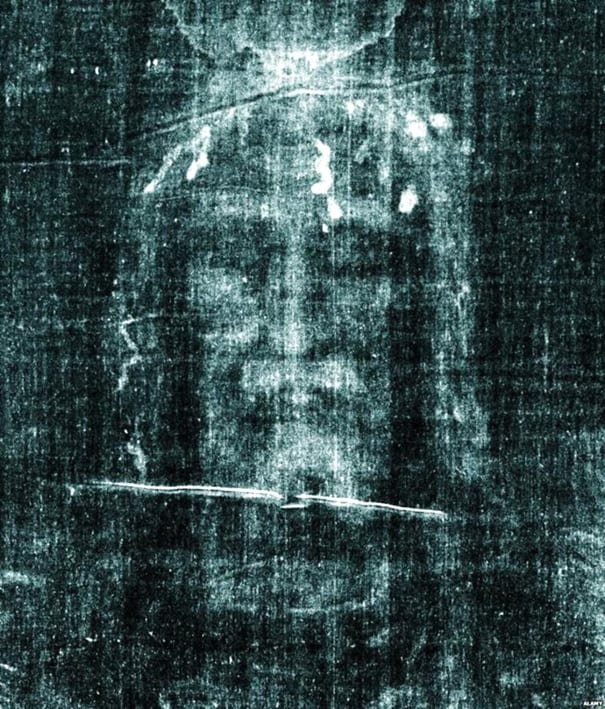
Introduction: 1024 X 1200
Here above, the piece of cloth known as the Holy Shroud and preserved in Turin cathedral to be the actual winding sheet of the crucified Christ
What is the scientific evidence for the authenticity of the Shroud of Turin?
the different investigations that played their part in the ongoing Shroud research and their findings
Data that seem to support its authenticity:
1 Photographic data
The image is a photographic negative on a non-photographic sensitive linen.
2 Holographic data
Eric Jumper, who went on to found the Shroud of Turin Research Project (STURP), made computer scans by a VP-8 image analyser that NASA designed when they mapped the surfaces of the moon, it measures light intensities to see where the valleys and hills are situated. While a normal picture doesn’t contain that information, the Shroud does contain this light intensity 3D information, which transformed the image into a three-dimensional map of the body. This was sufficient to show that the image was not a painting – for “how could a two-dimensional painting ever include three-dimensional information of a real body?”
The Shroud is encoded with 3D information.
The Shroud of Turin Research Project
1981 official STURP report:
— No paints, pigments, or dyes have been found on the image bearing thread fibers.
— The image is not the work of an artist.
–There are no chemical or physical methods known which can account for the totality of the image.
3 Anatomical data
Information not observable to the naked eye showed a mass of injuries, wounds in the wrists and feet and innumerable bloodstains.
Anatomical analysis further revealed the image to be the figure of a man just under six foot, with a gash in his side, his face beaten;
4 The Bloodstains are Consistent with Roman Crucifixion
To further reiterate the significance of the blood stains on the cloth, researchers have pointed to the fact that they perfectly resemble what is now known about Roman crucifixions. In Christian art, particularly in the Middle Ages, Jesus is frequently depicted as having nails going through the palms of his hands and the fronts of His feet. However, what we now know about the Roman crucifixion, based on skeletons of crucifixion victims, is that nails went through the wrists and the heels.
And his legs unbroken.
5 Data from Textile analysis
Textile analysis of the material of the Shroud showed it was made of linen with a weave pattern (it’s called a three in one herringbone weave, it was never found in Europe in any time in history) and stitching similar to first century Middle Eastern Jewish burial practices. There has also been pollen analysis, a study of the origins of the helmet-like covering of thorns that caused trauma to the head, and analysis of the blood on the Shroud. No brush strokes or paint pigment have been found.
6 Data from blood analysis
Unique about the blood on the Shroud is that it is still red. When blood goes out of the body it turns dark within a day, however the blood on the Shroud is still bright red after centuries.
In the 20th century it was discovered that when a person suffers a severe loss of blood volume, then the body responds so that the liver produces a unique protein called bilirubin which enters into the bloodstream for the purpose of speeding up the release of oxygen. It bursts the red blood cells, so oxygen can get to the oxygen starved tissues to keep them alive. This protein will stay bright red after it leaves the body. This shows that the blood on the Shroud is the blood of a man that suffered a severe trauma and loss of blood.
7 Data from forensic research
Forensic evidence suggests the shroud of Turin may date to the first century.
In 2015 two chemical method and one tensile strength method of testing have been done.
The results of these 3 method of testing overlapped in the first century.
8 Historical data from literature
Descriptions of the shroud date from the 1st, 5th 6th 8th 12th and 14th century.
This charts a journey beginning in Edessa in Turkey, where the Image of Edessa was venerated for many centuries. nd Constantinople, Athens, France, and finally Turin, the capital of the royal house of Savoy.
These data are strongly supported by the data from Botany – pollen analysis
9 Historical iconographical data (paintings)
It is worth noting that the historical Image of Edessa, documented in 593, bears a remarkable resemblance to the face of the man on the Shroud, leading to the suggestion that it was the actual Shroud, folded in four to show only the face and known as a “tetradiplon”.
Certainly, icons, frescos and paintings of the face of Christ, such as the tenth-century mosaic of Christ in Hagia Sophia, Istanbul, bear a remarkable similarity to the features of the face on the Shroud as revealed by modern science.
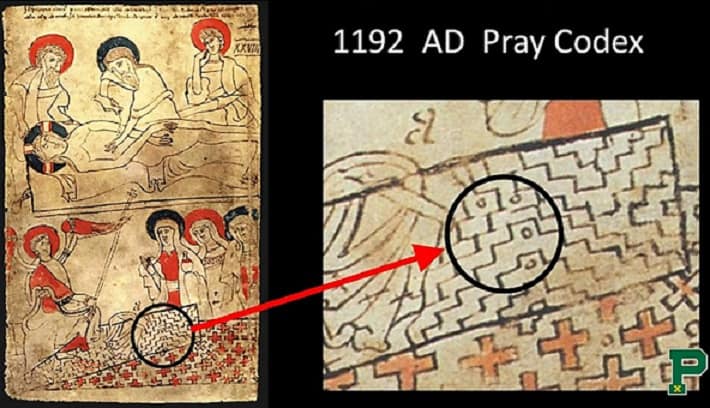
From https://www.youtube.com/watch?v=uu13Q5B98eg
This parchment from 1192 is the oldest surviving parchment and can be seen in the library museum in Budapest, Hungary, which shows the three in one herringbone weave, a stair step pattern.
10 Data from Mass Spectrometer analysis
STURP concluded that the image was not a painting. Several people have claimed to reproduce the appearance of the image by different “painting” methods, but none have used the observational methods used by STURP to test their hypotheses
–No paints, pigments or dyes have been found on the image bearing thread fibers.
–The image is not the work of an artist.
–There are no chemical or physical methods known which can account for the totality of the image.
11 Data from image enhancement techniques concerning coins
The image on the Shroud has coins over the eyes, which was according to the customs in the 1st century in Palestine
New technology offers additional proof of the authenticity of the Shroud of Turin:
In an interview with RCF Liège, the numismatist Agostino Sferrazza addressed the old question on the coins that cover the eyes of the Man of the Shroud. According to his conclusions, these pieces must have been coined in the days of Pontius Pilate, circa the year 29. This could constitute an additional proof of the authenticity of the Shroud of Turin.
Back in 1976, the hypothesis of the presence of coins covering the eyes of the Man of the Shroud was first introduced, thanks to a 3D projection of the mysterious image. In it, scientists note the presence of small bulges on the ocular orbit bones which wouldn’t match any possible morphological particularities. The hypothesis states these might have been leptons: small coins of low value that were common in Palestine in Roman times.
Drawings and letters on the coins
These initial observations were pushed further. Using advanced technologies, researchers have tried to identify drawings and inscriptions on these alleged coins. On the disc covering the right eye, apparently a “lituus” (a curved augural staff used in Roman religion) can be observed. On the disc over the left eye, we find a sacrificial cup. Those who refute the authenticity of these findings are expected to also reject this theory quite vigorously, suggesting that those who want the Shroud to be dated to the time of Christ are “willing themselves” to see the imprint coins where only simple interwoven textile fibers are to be found.
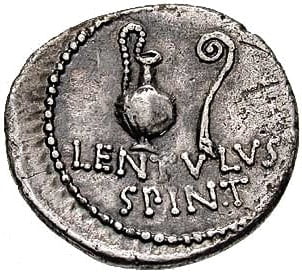
But these refutations can be contrasted with further evidence. Besides the drawings, researchers have managed to read the letters YKAI in the coins. This is thought to be the visible part of the word “TIBERIOY KAICAPOC”, Greek for Tiberius Caesar; that is, Emperor Tiberius. This would be a strong indication that these coins are comparable with other currencies from the Roman era, and might indeed be pieces that were being used at the time of Jesus’ Passion.
Coined in the year 29
In his interview with RCF Liège, Agostino Sferrazza supports the theory of the authenticity of the pieces and dates them to the time of Pontius Pilate. This theory is based on the images produced by computer scientist Nello Balossino, an associate professor at the Turin Faculty of Sciences, who succeeded in bringing out an image of the sacrificial cup on the right eye of the Man of the Shroud. According to Agostino Sferazza, there is no doubt: these pieces were indeed coined in 29 AD.
12 The data from Botany: pollen analysis
Dr. Max Frei who is a Swiss criminologist and a botanist, who did take pollen samples off the Shroud to pull off pollen grains. Analysing those pollen grains he could see what kind of plants the Shroud has been exposed to and even during which season.
And after analysing those pollen samples
Dr. Frei found the following:
204 different pollen samples<
49 different species
13 species being unique to Jerusalem
Several species unique to Constantinople
Dr. Frei came to the following conclusion:
“The pollen-spectrum as described is the most valuable conformation of the theory that the Shroud travelled from Palestine through Anatolia (Turkey) to Constantinople, France and Italy.”
In the 70s the Swiss botanist Max Frei Sulzer took some dust samples from the Shroud of Turin and the Sudarium of Oviedo to investigate the origin of the pollen which was on the two fabrics. He concluded that both the relics came from the Middle East and arrived in Europe through different paths. His work, which was carried out without providing sufficient methodological information
Besides being the founder and director of the Criminal Police of Zurich Scientific Service, he was Professor in the Zurich University and in the Institute of Police of Neuchatel (Switzerland) and Hiltrup (Germany) );he was also science editor of the German periodical Kriminalistik and UN expert witness in the investigation on the death of the General Secretary Dag Hammarskjöld
In five years of work, Frei was able to identify 49 species of plants, the pollen of which is represented in the dust of the Shroud
The conclusions of the Swiss botanist are interesting: “The presence on the Shroud of pollen of 29 plants of the Near East, and especially of 21 plants that grow in the desert or the steppes, directly leads to the hypothesis that the Shroud, now preserved in Turin, in the past was exposed to open air in countries where these plants are part of the normal vegetation. (…) Three-quarters of the species found on the Shroud grow in Palestine, of which 13 species are very characteristic or unique of the Negev and the Dead Sea area (halophyte plants). The palynology thus allows us to say that during its history (including manufacturing)the Shroud resided in Palestine.
the Shroud must have been exposed to open air in Turkey because 20 of the found species are abundant in Anatolia (Urfa, etc..) and four around Constantinople, and are completely lacking in the Central and Western Europe” Frei added important clarifications: “Because the geographic side of the Shroud’s past speaks in favor of authenticity .
He noted: “Some of the lists, published by the University of Tel Aviv, of pollen extracted from the bottom of the Dead Sea or the Lake of Gennesaret contain many identical names to the lists of the Shroud pollen published by me in 1978”22.The botanist Avinoam Danin of the Hebrew University of Jerusalem (Israel) said: “As far as establishing the Shroud’s provenance, Zygophyllum dumosumis the most significant plant on the list. Max Frei identified pollen grains of this species on the adhesive tapes he examined. The northern most extent of the distribution of this plant in the world coincides with the line between Jericho and the sea level marker on the road leading from Jerusalem to Jericho. As Zygophyllum dumosum grows only in Israel, Jordan and Sinai, its appearance helps to definitively limit the Shroud’s place of origin”
https://www.shroud.com/pdfs/marinelli2veng.pdf
13 The extraordinary details
No art historian would place an image of this quality as an artistic representation within the 13th century
14 Measurements of the Shroud
The Shroud dimensions are in units that were used in Jerusalem at the time of Christ, the cubit
15 The uniqueness of the Shroud
The Shroud is a very unique artifact, non-other relic in the world has its extraordinary properties.
16 The data from Geology
The dust on the Shroud was a very unique type of earth called travertine aragonite and its only found in Jerusalem from the limestone quarries.
17 A similar shroud dates to at least the fifth century
The Sudarium of Oviedo is a piece of cloth kept at Cathedral of San Salvador, within the Camara Santa (holy chamber), in Oviedo, Spain. Many of the faithful believe that it was the cloth used to wrap the face of Christ when He was buried. It has reliably been dated to at least the fifth century, and its history for at least a century prior can be accurately traced. If the Shroud of Turin can be connected to the Sudarium of Oviedo, then it is likely much, much older than even the 12th century.
As it turns out, not only was the image on the Shroud of Turin made with human blood, but it was of the same blood type – AB – as the blood on the Sudarium of Oviedo. AB blood is the rarest type in the world, so the fact that it is found in both shrouds is not likely to be a coincidence. Additionally, the facial images on both of the coverings match up exactly, showing that they were probably both used on the same person. Not only is the blood stain a match, but so is the pattern of pre-mortem and post-mortem blood. The forensic evidence gathered is strong enough to reasonably conclude that both clothes were used on the same body. The Shroud of Turin is probably the fifth century, if not earlier.
18 The burial ritual as is to distract from the Shroud corresponds to what is known from burial rituals in the first-century Palestine.
There are several remarkable details regarding the shroud that suggests that not only is it not a Medieval fake, but it can be reliably placed within what is known about first-century Palestine. For one, Jewish law required that a body had to be wrapped in linen cloth that had not been mixed with wool. The Shroud of Turin is made of linen, and though there are traces of cotton in it, there is no wool. It also corresponds precisely with the measuring unit that was used by first-century Jews, the cubit. It is exactly two cubits wide and eight cubits long.
Furthermore, the Shroud of Turin seems to perfectly match the burial cloth that is described in the book of John. The gospel says that many clothes were used – the Sudarium of Oviedo, the Shroud of Turin, and probably also strips of cloth to securely wrap the shroud around the body, evidence of which can also be seen on the Shroud of Turin. If it corresponds not only to the cover of Constantinople and the Sudarium of Oviedo but also to the shroud described in John, then it may be more than a first-century burial cloth. It may be the shroud that was used to wrap the body of Jesus after His death.
19 The Shroud has undergone 123 different scientific tests
With the most sophisticated equipment that was available.
20 The identity of the person who’s image is on the Shroud
As the Romans crucified thousands of people, the question could be, was this Christ?
But the image shows bleedings from a crown of thorns, this was unique to Christ.
21 Non-replicability
Many people thought that the most famous relic in Christendom was a fake, but despite many attempts, no one has been able to determine who the forger was or how the forgery might have been done.
Even today with the most sophisticated modern technology (Laser and so on) it is totally impossible to replicate the Shroud of Turin.
22 The riddle of the radio-carbon dating finally solved
After 1978 all data seemed to point in the direction that the Shroud of Turin was authentic
Problematic dating in 1988.
However a radiocarbon dating test carried out in 1988 did place the Shroud not earlier than 1260.
So there was an enormous discrepancy between more than 20 lines of evidence and the results of the radiocarbon dating test of1988.
On logical grounds one can dismiss a single line of evidence which contradicts more than 20 lines of evidence based upon the parsimony principle.
But it was not that simple; a radiocarbon dating test is generally considered to be extremely reliable and based upon sound scientific principles
But then new data came in:
Turin Shroud: The New Evidence (Shroud of Turin) | History Documentary
https://www.youtube.com/watch?v=NVovTvDjjCg
Mark 15:46
So Joseph bought some linen cloth, took down the body, wrapped it in the linen, and placed it in a tomb
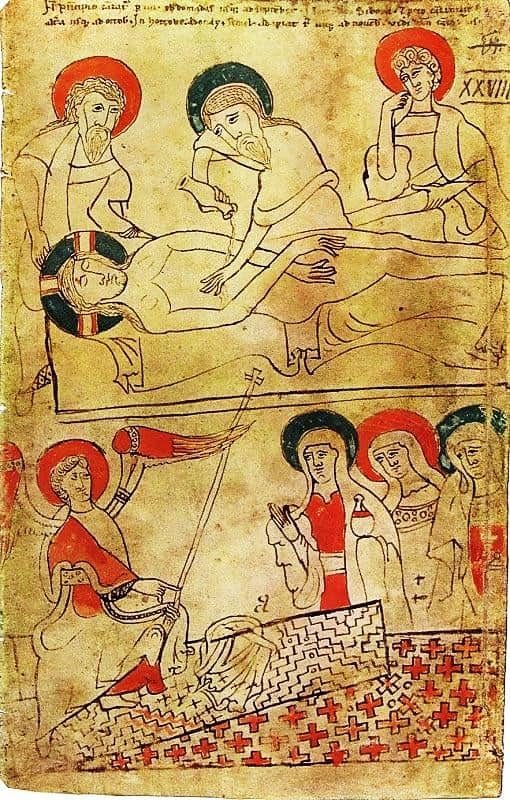
Page from the Pray Codex. bp.blogspot.
“Shroud of Turin older than thought.” BBC. January 31, 2005.
This year sees the 20th anniversary of the Carbon 14 dating of the Shroud of Turin that deemed the most famous relic in Christendom a fake. But since then, despite many attempts, no one has been able to determine who the forger was or how the forgery might have been done. This documentary sets out to discover exactly what it is about the image on the Shroud of Turin that has defied imitation and explores new evidence that may challenge the Carbon 14 verdict.
“Shroud of Turin older than thought.” BBC. January 31, 2005.
The Shroud of Turin is much older than suggested by radiocarbon dating carried out in the 1980s, according to a new study in a peer-reviewed journal. A research paper published in Thermochimica Acta suggests the shroud is between 1,300 and 3,000 years old. The author dismisses 1988 carbon-14 dating tests which concluded that the linen sheet was a medieval fake. The shroud, which bears the faint image of a blood-covered man, is believed by some to be Christ’s burial cloth.
Raymond Rogers says his research and chemical tests show the material used in the 1988 radiocarbon analysis was cut from a medieval patch woven into the shroud to repair fire damage. It was this material that was responsible for an invalid date being assigned to the original shroud cloth, he argues. “The radiocarbon sample has completely different chemical properties than the main part of the shroud relic,” said Mr Rogers, who is a retired chemist from Los Alamos National Laboratory in New Mexico, US. Fire damage He says he was originally dubious of untested claims that the 1988 sample was taken from a re-weave. “It was embarrassing to have to agree with them,” Mr Rogers told the BBC News website. The 4m-long linen sheet was damaged in several fires since its existence was first recorded in France in 1357, including a church blaze in 1532. It is said to have been restored by nuns who patched the holes and stitched the shroud to a reinforcing material known as the Holland cloth. “[The radiocarbon sample] has obvious painting medium, a dye and a mordant that doesn’t show anywhere else,” Mr Rogers explained.
“This stuff was manipulated – it was coloured on purpose.” In the study, he analysed and compared the sample used in the 1988 tests with other samples from the famous cloth. In addition to the discovery of dye, micro chemical tests – which use tiny quantities of materials – provided a way to date the shroud. These tests revealed the presence of a chemical called vanillin in the radiocarbon sample and in the Holland cloth, but not the rest of the shroud. Vanillin is produced by the thermal decomposition of lignin, a chemical compound found in plant material such as flax. Levels of vanillin in material such as linen fall over time. ‘Older date’ “The fact that vanillin cannot be detected in the lignin on shroud fibres, Dead Sea scrolls linen and other very old linens indicates that the shroud is quite old,” Mr Rogers writes. “A determination of the kinetics of vanillin loss suggests the shroud is between 1,300 and 3,000 years old.” In the 1988 study, scientists from three universities concluded that the cloth dated from some time between 1260 and 1390. This ruled it out as the possible burial cloth that wrapped the body of Christ.
That led to the then Cardinal of Turin, Anastasio Alberto Ballestrero, admitting the garment was a hoax. Michael Minor, vice-president of the American Shroud of Turin Association for Research, commented: “This is the most significant news about the Shroud of Turin since the C-14 dating was announced in 1988. “The C-14 dating isn’t being disputed. But [the new research] is saying that they dated the rewoven area.” But since the announcement of the 1988 results, several attempts have been made to challenge the authenticity of these tests. “The sample tested was dyed using technology that began to appear in Italy about the time the Crusaders’ last bastion fell to the Mameluke Turks in AD 1291,” said Mr Rogers. “The radiocarbon sample cannot be older than about AD 1290, agreeing with the age determined in 1988. However, the shroud itself is actually much older.” Some now hope the Vatican will give approval for samples of the shroud to be re-tested. But, says Mr Minor, “the church is very hesitant, very reluctant for that to be done, because they’ve been given so many conflicting opinions” |
See further: https://www.youtube.com/watch?v=NVovTvDjjCg
Ray Rogers one of the leading members of the research team, a highly respected chemist from the Los Alamos national laboratory:
On January 20, 2005, a paper by Roy Rogers , leader of STURP’S Chemistry Group , was published in “THERMOCHIMICAACTA,”a highly respected peer reviewed scientific journal .
The paper concludes :
The combined evidence from chemical kinetics , analytical chemistry , cotton content , and pyrolysis/mass spectrometry proves that the material from the radiocarbon area of the shroud is significantly different from that of the main cloth .
The radiocarbon sample was thus not part of the original cloth and is invalid for determining the age of the shroud .
“https://www.shroudofturin.com“
From the Shroud center in Colorado.
Especially interesting is the ‘fall through’ theory.
The mass of evidence will convince any reasonable person that the Shroud could not be faked.
Also the Sudarium of Oviedo has dozens of corresponding blood stains and provenance to a much earlier time (pre 700 AD) than the Shroud.
The Shroud is obliquely referred to by Paul -and it’s history was hidden because of the vicious persecution of the Church – to prevent it being destroyed.
It was cotton fiber in the Shroud repair that slewed the carbon 14 test and they only took 1 sample instead of the protocol 7. Deliberate misfeasance.
Textile analysis of the material of the Shroud showed it was made of linen with a weave pattern and stitching similar to first century Middle Eastern Jewish burial practices.
The shroud was damaged in a fire in 1532 in the chapel in Chambery, France. There are some burn holes and scorched areas down both sides of the linen, caused by contact with molten silver during the fire that burned through it in places while it was folded.[22] Fourteen large triangular patches and eight smaller ones were sewn onto the cloth by Poor Clare nuns to repair the damage.
——————————————————————————————
The coming Kingdom of God
The Kingdom of God (and its related form the Kingdom of Heaven in the Gospel of Matthew) is one of the key elements of the teachings of Jesus in the New Testament. Drawing on Old Testament teachings, the Christian characterization of the relationship between God and humanity inherently involves the notion of the Kingship of God.
Jesus association of his own person and ministry with the “coming of the kingdom” indicates that he perceives that God’s great intervention in history has arrived and that he is the agent of that intervention. However, in the Parable of Mustard Seed,[Jesus seems to indicate that his own view on how the kingdom of God arrives differs from the Jewish traditions of his time. It is commonly believed that this multiple-attested parable suggests that the growth of the kingdom of God is characterized by a gradual process rather than an event, and that it starts small like a seed and gradually grows into a large firmly rooted tree.
His suffering and death, however, seem to cast doubt upon this (how could God’s appointed king be killed?) but his resurrection affirms his claim with the ultimate proof of only God having resurrection power over death. The claim includes his exaltation to the right hand of God establishes him as “king.” Jesus’ predictions of his return make it clear that God’s kingdom is not yet fully realized according to inaugurated eschatology but in the meantime the good news that forgiveness of sins is available through his name is to be proclaimed to the nations. Thus the mission of the Church begins and fills the time between the initial coming of the Kingdom, and its ultimate consummation with the Final Judgment.
Jesus Christ, his death and resurrection, his return, and the rise of the Church in history. A question characteristic to the central theme of most interpretations is whether the “kingdom of God” has been instituted because of the appearance of Jesus Christ or whether it is yet to be instituted; whether this kingdom is present, future or is omnipresent simultaneously in both the present and future existence.
Eschatology
Interpretations of the term Kingdom of God have given rise to wide-ranging eschatological debates among scholars with diverging views, yet no consensus has emerged among scholars. From Augustine to the Reformation the arrival of the Kingdom had been identified with the formation of the Christian Church, but this view was later abandoned by some Christian Churches and by the beginning of the 20th century, some Protestant churches had adopted the apocalyptic interpretation of the Kingdom.In this view (also called the “consistent eschatology”) the Kingdom of God did not start in the first century, but is a future apocalyptic event that is yet to take place.
By the middle of the 20th century, realized eschatology, which viewed the Kingdom as non-apocalyptic but as the manifestation of divine sovereignty over the world (realized by the ministry of Jesus), had gathered a scholarly following. In this view the Kingdom is held to be available in the present. The competing approach of inaugurated eschatology was later introduced as the “already and not yet” interpretation. In this view the Kingdom has already started, but awaits full disclosure at a future point. These diverging interpretations have ce given rise to a good number of variants, with various scholars proposing new eschatological models that borrow elements from these.
There is no general agreement on the interpretation of the term Kingdom of God. (Wikipedia)
,
Kingdom of God (M.J.M)
The name given by Christ to the collective transformation, that will take place when the energy of the highest ontological level (what is traditionally called the Divine), activated through feedback loops, descents all the way down into the physical world.
Divinisation (M.J.M)
A process in which a person or humanity transforms by coming in union with the Divine which is the totality of the energetic processes on the highest ontological levels.
Divanisation on an individual level it is also called: Glorification, Deification, Apotheosis
On a collective level it refers to a Kosmic transformation by which Kosmic ontological feedback loops are activated.
Divinisation on an individual level it is also called:
Lurianic Kabbalah : Tikkun‘ Olam (cosmic restitution)
Book of revelations 21:1-7 : A new Heaven and a New Earth
Hopi (Pahana) : End of the current Fourth world, beginning
of the Fifth world
Hindu (Avatar) : Descent of the Divine awareness
Christ described it as : The kingdom of God.
Click here for more details
Faith (M.J.M)
Unfortunately what is called faith are generally a set. of dogmatic proclamations
Faith in its pure spiritual sense isn’t conceptual it is perceptual
It isn’t an agreement with a set of propositions, it is the direct perception and contact with the transcendent totality
Paradise (M.J.M)
Introduction:
The paradise story which is to be found in Genesis 2. 4-25 and 3. 1-24. It wasn’t included in the original book of Genesis. Fabre d’Olivet in his book: “Hebraic Tongue Restored uses a literary source which is from about 1000 BC in which the paradise story is not included”.
The term paradise comes from an Persian source; Avestan: Pairidaeza “enclosure, park” which could be interpreted as an “orchard” or a “fruit garden”. The data seem to suggest that the story was added in the 6th century BC.
Synopsis and interpretation:
Genesis 2
Adam and Eve
4 This is the account of the heavens and the earth when they were created, when the Lord God made the earth and the heavens.5 Now no shrub had yet appeared on the earth and no plant had yet sprung up, for the Lord God had not sent rain on the earth and there was no one to work the ground, 6 but streams came up from the earth and watered the whole surface of the ground. 7 Then the Lord God formed a man from the dust of the ground and breathed into his nostrils the breath of life, and the man became a living being.
The breath of life: The Hebrew word for it is Nephesj, animating force.
8 Now the Lord God had planted a garden in the east, in Eden; and there he put the man he had formed. 9 The Lord God made all kinds of trees grow out of the ground—trees that were pleasing to the eye and good for food. In the middle of the garden were the tree of life and the tree of the knowledge of good and evil.10 A river watering the garden flowed from Eden; from there it was separated into four headwaters. 11 The name of the first is the Pishon; it winds through the entire land of Havilah, where there is gold. 12 (The gold of that land is good; aromatic resin and onyx are also there.) 13 The name of the second river is the Gihon; it winds through the entire land of Cush.14 The name of the third river is the Tigris; it runs along the east side of Ashur. And the fourth river is the Euphrates.
The Garden of Eden symbolizes a transcendental reality where the soul and the spirit remain. The idea is that this reality does not relate to a physical world, but to a higher non-physical subtle reality. Both Christ and St. Paul did use the word paradise for a supernatural world.
(The word paradise is usually used as a synonym for “heaven” (Revelation 2:7).
When Jesus was dying on the cross and one of the thieves being crucified with Him asked Him for mercy, Jesus replied, “I tell you the truth, today you will be with me in paradise” (Luke 23:43). Jesus knew that His death was imminent and that He would soon be in heaven with His Father. Therefore, Jesus used “paradise” as a synonym for “heaven.” The apostle Paul wrote of someone (probably himself) who “was caught up to paradise” (2 Corinthians 12:3). In this context, paradise obviously refers to heaven).
15 The Lord God took the man and put him in the Garden of Eden to work it and take care of it. 16 And the Lord God commanded the man, “You are free to eat from any tree in the garden; 17 but you must not eat from the tree of the knowledge of good and evil, for when you eat from it you will certainly die.”
Here one finds for the first time the concept of immortality. If you eat from the tree of knowledge of good and evil then you become mortal. From which follows the conclusion that one isn’t mortal, as long as one does not eat of this tree. This immortality means that it is not a physical existence which is described here, because then, by definition, one is mortal.
18 The Lord God said, “It is not good for the man to be alone. I will make a helper suitable for him.”19 Now the Lord God had formed out of the ground all the wild animals and all the birds in the sky. He brought them to the man to see what he would name them; and whatever the man called each living creature, that was its name. 20 So the man gave names to all the livestock, the birds in the sky and all the wild animals. But for Adam no suitable helper was found.
Here we find the name “Adam”. According to the Kabbalah Adam is the heavenly man, who portrays the divine in man: The divine spirit, the Atman, the monad, the highest aspect of the human being. According to the Kabbalah, Adam was clothed with light and not yet with meat, and therefore he is not considered to be physical.
21 So the Lord God caused the man to fall into a deep sleep; and while he was sleeping, he took one of the man’s ribs and then closed up the place with flesh. 22 Then the Lord God made a woman from the rib he had taken out of the man, and he brought her to the man.23 The man said, “This is now bone of my bones and flesh of my flesh; she shall be called ‘woman,’ for she was taken out of man.”
From a higher aspect, the spirit, the monad (personified as Adam), originates now another aspect, the soul (personified as Eve).
24 That is why a man leaves his father and mother and is united to his wife, and they become one flesh. 25 Adam and his wife were both naked, and they felt no shame.
When the spirit is united with the soul, it leaves its origin, the divine. That they were both naked refers to the state were the spirit and soul are not being “clothed” with a physical body. Genesis 3
The Fall
3 Now the serpent was more crafty than any of the wild animals the Lord God had made. He said to the woman, “Did God really say, ‘You must not eat from any tree in the garden’?” 2 The woman said to the serpent, “We may eat fruit from the trees in the garden, 3 but God did say, ‘You must not eat fruit from the tree that is in the middle of the garden, and you must not touch it, or you will die.” 4 “You will not certainly die,” the serpent said to the woman. 5 “For God knows that when you eat from it your eyes will be opened, and you will be like God, knowing good and evil.” 6 When the woman saw that the fruit of the tree was good for food and pleasing to the eye, and also desirable for gaining wisdom, she took some and ate it. She also gave some to her husband, who was with her, and he ate it. 7 Then the eyes of both of them were opened, and they realized they were naked; so they sewed fig leaves together and made coverings for themselves.
The eating the fruit of the tree of knowledge of good and evil symbolizes the pursuit of knowledge and further development, for which it is necessary that a physical body is been taken on. And by that one becomes mortal. The spirit and the soul become aware of the absence of a physical body.
8 Then the man and his wife heard the sound of the Lord God as he was walking in the garden in the cool of the day, and they hid from the Lord God among the trees of the garden. 9 But the Lord God called to the man, “Where are you?” 10 He answered, “I heard you in the garden, and I was afraid because I was naked; so I hid.” 11 And he said, “Who told you that you were naked? Have you eaten from the tree that I commanded you not to eat from?” 12 The man said, “The woman you put here with me—she gave me some fruit from the tree, and I ate it.” 13 Then the Lord God said to the woman, “What is this you have done?” The woman said, “The serpent deceived me, and I ate.”
The soul (Eve) draws the spirit (Adam) along toward materialization. Adam and Eve symbolize two aspects of one person. The snake symbolizes instinctive desire.
14 So the Lord God said to the serpent, “Because you have done this, “Cursed are you above all livestock and all wild animals! You will crawl on your belly and you will eat dust all the days of your life. 15 And I will put enmity between you and the woman, and between your offspring and hers; he will crush your head, and you will strike his heel.” 16 To the woman he said, “I will make your pains in childbearing very severe; with painful labour you will give birth to children. Your desire will be for your husband, and he will rule over you.” 17 To Adam he said, “Because you listened to your wife and ate fruit from the tree about which I commanded you, ‘You must not eat from it,’ “Cursed is the ground because of you; through painful toil you will eat food from it all the days of your life. 18 It will produce thorns and thistles for you, and you will eat the plants of the field. 19 By the sweat of your brow you will eat your food until you return to the ground, since from it you were taken; for dust you are and to dust you will return.” 20 Adam named his wife Eve, because she would become the mother of all the living.
When the spirit and the soul take on a physical body, shall what they give birth to: Wishes and desires, bring conflicts with it.
21 The Lord God made garments of skin for Adam and his wife and clothed them. 22 And the Lord God said, “The man has now become like one of us, knowing good and evil. He must not be allowed to reach out his hand and take also from the tree of life and eat, and live forever.” 23 So the Lord God banished him from the Garden of Eden to work the ground from which he had been taken. 24 After he drove the man out, he placed on the east side of the Garden of Eden cherubim and a flaming sword flashing back and forth to guard the way to the tree of life.
That God clothes Adam and Eve with garments of skin, indicates that they obtain a physical body.
This is also to be found within philosopher J.J.Poortman’s: Vehicles of consciousness: “……in the anthropological context, the text in Genesis in which we are told that ”the Lord made for Adam and for his wife garments of skin, and clothed them”(Gen. 3. 21). It is obvious that these were a primitive kind of ordinary garment of the type that the Neanderthal man is often depicted as wearing, made of skins of animals…..a “last garment” of man has been perceived by a number of writers in these “garments of skins”, in other words, man’s ordinary body as a whole (the skin was something that he had in common with the animals) in contrast to other more subtle bodies or garments. In this, the point of departure was the idea of a descent through the spheres, in which case the whole point of departure was the idea of a descent through the spheres”.
That they are banished from the Garden of Eden symbolises that the spirit and the soul leave the higher ontological world and go into the physical world. When the spirit and the soul have taken on a physical body they cannot go back. That they cannot go back is symbolised by the cherubim with a flaming sword.
The fall
The doctrine of the fall of man is extrapolated from Christian exegesis of Genesis 3. According to the narrative, God creates Adam and Eve, the first man and woman. God places them in the Garden of Eden and forbids them to eat fruit from the tree of knowledge of good and evil. The serpent tempts Eve to eat fruit from the forbidden tree, which she shares with Adam and they immediately become ashamed of their nakedness. Subsequently, God banishes Adam and Eve from the Garden of Eden, condemns Adam to working in order to get what he needs to live and condemns Eve to giving birth in pain, and places cherubim to guard the entrance, so that Adam and Eve will not eat from the “tree of life”.
Interpretation (M.J.M):
Adam and Eve are expelled from the Garden lest they eat of the second tree, the tree of life, and gain immortality [Gen. 3:22].
Genesis 3:22 New Revised Standard Version (NRSV):
22 Then the Lord God said, “See, the man has become like one of us, knowing good and evil; and now, he might reach out his hand and take also from the tree of life, and eat, and live forever”—
Mortality
Here it is put forward that when man eats from the tree of knowledge of good and evil, on becomes mortal and:
Immortality
Genesis 2:17 (“for in the day that you eat of it you shall die”) but when on eats from the tree of life one will live forever,
The fall means that the soul now takes on a physical body, it is now born into the physical world.
The tree of knowledge of good and evil, is the connection from the higher world to the physical world.
That the tree of life makes the connection from the physical world to the divine world, means that the soul which has gone through the physical incarnation, despite the deep involvement, can go to a higher level of existence than would otherwise had been the case.
(This is symbolised in the parable of the prodigal son).
This conceptualisation provides a metaphysical framework within which the one can interpret the entire pattern of creation, the Fall of humanity, the incarnation, redemption, and last things.
The mystery of redemption .
Jesus knew in advance that He was going to be put to death. If so, why didn’t he avoid it?
M.J.M.:
We have to look into Christ motives, what does it mean:
”That he took the sins of the world upon him?”
What is meant with the concept of sin?
Sin
In a religious context, sin is a transgression against divine law. Each culture has its own interpretation of what it means to commit a sin. While sins are generally considered actions, any thought, word, or act considered immoral, selfish, shameful, harmful, or alienating might be termed “sinful”.
“sinning” is to follow the inclinations of one’s own lower nature (Wikipedia)
A list of some of these transgressions:
Anger: a strong feeling of annoyance, displeasure, or hostility. —Galatians 5:20; Ephesians 4:26, 31; 6:4; Colossians 3:8; James 1:19-20
Arrogance: unpleasantly proud and behaving as if one is more important than, or know more than, other people —2 Timothy 3:2; 2 Corinthians 12:20; 2 Timothy 3:2; 1 Corinthians 5:2; 8:1; 13:4
Bitterness: anger and disappointment. It is synonymous with resentment —Ephesians 4:31; Hebrews 12:15; Romans 2:24; 3:14; Acts 8:23; James 2:7
Boasting: excessively proud and self-satisfied talk about one’s achievements, possessions, or abilities. —Romans 1:30; 2 Timothy 3:2; Galatians 5:26
Brutality: cruel and violent treatment or behaviour —2 Timothy 3:3
Complaining—Ephesians 4:31; Colossians 3:13; 1 Peter 4:9; James 5:9
Conceit: yearn to possess (something, especially something belonging to another). —2 Timothy 3:4
Coveting: the expression of dissatisfaction or annoyance about something. —Mark 7:22; Ephesians 5:5; Acts 20:33; Romans 13:9
Cowardice: the behaviour of someone who is not at all brave and tries to avoid danger: —Revelation 21:8
Deceit: the action or practice of deceiving someone by concealing or misrepresenting the truth. —Mark 7:22; Acts 13:10; Romans 1:29; 1 Peter 3:10
Defrauding: to take something illegally from a person, or to prevent someone from having something that is legally theirs by deceiving them —1 Corinthians 6:7
Desiring praise of men —John 12:43
Enmities: a feeling of hostility or ill will, as between enemies ; antagonism —Galatians 5:20
Envy: to regard one with jealousy or resentment because of someone or something one has —Mark 7:22; Galatians 5:26; Titus 3:3
Evil thoughts—Mark 7:21; Matthew 15:19
False witnessing—Matthew 15:19
Fearfulness—Matthew 10:26, 28
Greed: intense and selfish desire for something, especially wealth, or power. —Ephesians 4:19; 5:3; 2 Peter 2:14
Lust, lusting: an uncontrolled or illicit desire —1 Peter 4:3; Titus 3:3
Hatred: the feeling of intense dislike or extreme aversion or hostility. —2 Timothy 3:3; Titus 3:3
Hypocrisy: the practice of claiming to have higher standards or more noble beliefs than is the case. —Matthew 23:13,23, 25; 23, 27,28, 29; Mark 12:15; Luke 12:1; Romans 12:9
Immorality: behaviour that is morally wrong, or outside society’s standards of what is acceptable —Galatians 5:19; Revelation 21:8; Ephesians 5:3
Jealousy: state or feeling of being envious or of wanting what someone else has —Galatians 5:20; 1 Corinthians 3:3; 2 Corinthians 12:20; James 3:16
Judging: to express a bad opinion of someone’s behaviour, often because one thinks to be better than them —Matthew 7:1-5; Romans 2:1; 14:13; Luke 6:37 James 4:11:
The Bible says about judging others:
Matthew 7 :: NIV. “Do not judge, or you too will be judged. For in the same way you judge others, you will be judged, and with the measure you use, it will be measured to you. “Why do you look at the speck of sawdust in your brother’s eye and pay no attention to the plank in your own eye?
Knowing to do good but not doing it—James 4:17
Laying up treasures on earth—Matthew 6:19-21; 19:21; 1 Timothy 6:9-10; Luke 12:21, 33; 18:22
Living for pleasure—2 Timothy 3:4
Lovers of self—2 Timothy 3:2
Lying: telling or containing lies; deliberately untruthful; deceitful; false —Revelation 21:8, 27; 22:15; Ephesians 4:25; Romans 9:1; 2 Corinthians 11:31; Galatians 1:20; 2 Timothy 2:7
Malice: The desire to cause pain, injury, or distress to another. —Romans 1:29; Ephesians 4:31; Colossians 3:8; Titus 3:3; 2 Peter 2:1
Murder: the premeditated killing of one human being by another —Revelation 21:8; Mark 7:21; 5:21; 10: 19; 19:18; Luke 18:20; Romans 1:29; 1 Peter 3:15; 4:15; Matthew 15:19
Pride: conceit, self-esteem, egotism, vanity, vainglory imply an unduly favourable idea of one’s own appearance, advantages, achievements,—Mark 7:22; 1 Peter 5:5, 6; James 4:6; Matthew 23:12; Luke 14:11; 18;14
Quarrelsome: apt or disposed to quarrel in an often petty manner : contentious. —James 4:1-2; 1 Corinthians 1:11; 2 Timothy 2:23
Sensuality: relating to or consisting in the gratification of the senses or the indulgence of appetite : —Galatians 5:19; Mark 7:22; Romans 13:13; 2 Corinthians 12:21; 1 Peter 4:3; Ephesians 4:19; 2 Peter 2:2
Slander: the action of making a false spoken statement damaging to a person’s reputation. —Matthew 15:19; Mark 7:22; Ephesians 4:31; Colossians 3:8; 2 Peter 2:1; 1 Corinthians 4:13; Romans 1:30
Stealing: take (another person’s property) without permission or legal right and without intending to return it. —Ephesians 4:28; 13:9; Matthew 19:18; Mark 10:19; Luke 18:20; Romans 2:21; 13:9
Strife, quarrelling: angry or bitter disagreement over fundamental issues; conflict.—Galatians 5:20; Romans 1:29; 13:13; 1 Corinthians 3:3; 2 Corinthians 12:20; 1 Timothy 6:4
Swindling: use deception to deprive (someone) of money or possessions —1 Corinthians 5:10; 6:10
Thievery, theft: the action of stealing another person’s property. —1 Corinthians 6:10; Mark 7:21; John 10:1, 8; 1 Peter 4:15; Matthew 15:19
Treachery: behaviour that deceives or is not loyal to someone who trusts you… —2 Timothy 3:4
Unbelief, lack of faith—James 1:6; Mark 9:24; Hebrews 3:12, 19; 1 Timothy 5:8; 2 Corinthians 6:14-15; 7:13; 2 Corinthians 4:4; Titus 1:15; Revelation 21:8
Unforgiveness: unwilling or unable to forgive —Matthew 6:14-15; Mark 11:25-26
Ungratefulness: unappreciative; not displaying gratitude; not giving due return or recompense for benefits conferred —2 Timothy 3:2; Romans 1:21; Luke 6:35 .
—Romans 1:18, 29; 2:8; 6:13; 1 John 1:9; 5:17
Wickedness: departure from the rules of the divine or the moral law; evil disposition or practices; immorality; depravity —Mark 7:22; Luke 11:39; Acts 8:22; Romans 1:29; 1 Corinthians 5:8; Ephesians 6:12; 2 Thessalonians 2:10, 12; 2 Timothy 2:19
Wrath: strong, stern, or fierce anger; deeply resentful indignation —Ephesians 4:31; Colossians 3:8; 1 Timothy 2:8
So far the traditional interpretation of the concept.
While some rules may be local habits, many are universal principles.
(M.J.M)
Substitutionary atonement, also called vicarious atonement, is the idea that Jesus died “for us,” as propagated by the Western classic and objective paradigms of atonement in Christianity, which regard Jesus as dying as a substitute for others, “instead of” them. (Wikipedia)
So how to interpret this parable or story?
There is a more reasonable interpretation of this narrative
Metaphorical truth (M.J.M)
While this may be a metaphorical truth, there are great problems with seeing this as a literal truth:
First of all one puts human character traits and even very negative human character traits such as wrath and resentfulness on a transcendent kosmic force.
The question here is why an obvious very intelligent person as Christ decided to get crucified? Bearing in mind all the agonising and prolonged torment that preceded his death.
Rather than emphasizing a legal substitution or transfer of merits and that when Jesus descended into hades (variously, the underworld or hell, the abode of the dead) he eliminated what is traditionally described as the collective sin of mankind .
This would mean that Christ by his action did remove a great number of complexes of deep instinctive patterns from the collective unconscious .
As they are a great number of clusters of instinctual patterns that humanity inherited biologically from its ancestors, this can indeed be called inherited sin .
What the ancient Hebrews called sin is in modern terms now known to be instinctual behavior in places where social, rational, and moral behavior should function .
His descent to the underworld (collective unconscious ) is alluded to in the New Testament .The Catholic Catechism interprets Ephesians 4:9, which states that “Christ descended into the lower parts of the earth” (collective unconscious), as also supporting the idea of elimination of the collective sin of mankind.
This refers to what Christ did when he descended into the underworld, be it not in the three days between his death and his resurrection, but during his crucifixion
The interpretation given in relation to the three days doesn’t correspond with Christ his own announcement
We know from Jesus’ statement to the thief that when one dies they enters the presence of God immediately. Luke 23:42 states, “Truly I say to you, today you shall be with Me in Paradise.” This statement also tells us that Jesus went to His Father upon death; he ascended into heaven .
——————————————————————————————
Instincts
Modern psychological and neurological research has shown that much of human behavior is governed by instincts.
Impulses, driven by instincts, are serving specific biological functions.
Instincts are inborn patterns of activity or tendency to action common to a given biological species, performed in response to specific external stimuli. Instinct is generally described as a stereotyped, apparently unlearned, genetically determined behaviour pattern which do not require cognition or consciousness to perform.
These deep-seated impulses (e.g., “maternal instinct”), to ways of acting that do not appear to have involved learning or experience in their development, or to knowledge that is inborn or subconsciously acquired. (Encyclopedia Britannica)
Uncontrolled instinctive impulses can lead to
hedonism, lack of moral constraints, selfishness, self-deluded narcissism , conformity to corrupt systems.
To exertion of power at the expense of others.
Humans have ‘evolved psychological mechanisms’ with an instinctive basis.
Extremely specialized systems have evolved, resulting in individuals which exhibit behaviors without learning them.
That most of the human mind operate unconsciously.
The unconscious mind (or the unconscious) consists of the processes in the mind which occur automatically and are not available to introspection and include thought processes, memories, interests and motivations.
Unconscious phenomena include repressed feelings, automatic skills, subliminal perceptions, and automatic reactions, and possibly also complexes, the repository of forgotten memories (that may still be accessible to consciousness at some later time), and the locus of implicit knowledge (the things that we have learned
so well that we do them without thinking).
Even though these processes exist well under the surface of conscious awareness, they are theorized to exert an effect on behavior.
Psychology
The concept of sin (M.J.M)
Temptation
Sins are lower level instinctual patterns, aspects of unconscious life, which should be replaced with a higher level functioning.
So on one hand these lower level subconscious functions are absolutely necessary, but on the other hand higher conscious functions should transcend the lower.
The by instinct driven impulses are serving specific biological functions , these are unconscious processes.
If they wouldn’t be regulated by unconscious processes. then consciousness would be totally occupied with these lower processes and it would be impossible to develop higher mental functions, properties or capacities possessed by humans such as intellectual faculties like thinking, reasoning and memory, that allows humans to make sense of what is going on in the world, and to represent and interpret them in ways that are significant, or which accord with their needs, attachments, goals, commitments, plans, purposes, desires, etc.
Higher mental functions also involve the symbolic or semiotic mediation of ideas or data, as when we form concepts, engage in problem solving, reasoning, and making decisions.
Words that refer to similar concepts and processes include deliberation, cognition, ideation, discourse and imagination.
These higher mental functions are also deeply connected with our capacity to understand cause and effect; to recognize patterns of significance; to comprehend and disclose unique contexts of experience or activity; and to respond to the world in a meaningful way.
Memory is the ability to preserve, retain and subsequently recall knowledge, information, or experience. Imagination is the activity of generating or evoking novel situations, images, ideas or other qualia in the mind.
Among the many practical functions of imagination are the ability to project possible futures (or histories), to “see” things from another’s perspective, and to change the way something is perceived, including making decisions to respond to, or enact, what is imagined.
Humans are conscious of something or about something, a property known as intentionality in philosophy of mind.
Higher mental functions also involves logical thinking, well justified or obey the norms of rationality.
Rationality depends only on structural principles that govern how different mental states relate to each other .
All these higher mental functions couldn’t be activated if a great part of our mental activity wasn’t automatically unconscious regulated .
The unconscious
The unconscious is a force that can only be recognized by its effects—it expresses itself in the symptom.
Unconscious thoughts are not directly accessible to ordinary introspection,
The collective unconscious
The idea is that we’re all connected at a fundamental level. This is what Jung expressed in the idea of the collective unconscious, where all human consciousness would be interlinked, unified, interconnected.
The collective unconscious is therefore said by Jung to be inherited and contains material of an entire species rather than of an individual. Every person shares the collective unconscious with the entire human species.
”That Christ took the sins of the world upon him”, does mean that he transformed the deep clusters of instinctive complexes within the collective unconscious.
By his crucifixion he connected the energetic processes of the highest ontological level (the Divine), which were a part of his nature, with the depth of the collective unconscious. And by that he did create a transformation in a kosmic process.
The traditional explanations normally given in relation to why he deemed this necessary may be metaphorically true, but on a logical level doesn’t make any sense, and explains nothing.
That Christ eliminated with his actions deep collective and universal instinctive processes from the collective unconscious and liberated humanity from the bondage of sin.
This means that he transformed the clusters of deep instinctive complexes within the collective unconscious.
The collective unconscious is the matrix of all conscious psychic occurrences, and hence it exerts an influence that compromises the freedom of consciousness in the highest degree, since it is continually striving to lead all conscious processes back into the old paths.
The collective unconscious exerts overwhelming influence on the minds of individuals. These effects of course vary widely, since they involve virtually every emotion and situation. At times, the collective unconscious can terrify, but it can also heal.
Jung writes:
They evidently live and function in the deeper layers of the unconscious, especially in that phylogenetic substratum which I have called the collective unconscious.
——————————————————————————————
A Kosmic process
In a state outside space and time, what was called the Absolute- existed.
Unchanging, the spiritual ground of all being, that which exists by its own nature and is consequently independent of everything else
A state of pure consciousness.
The Ultimate.
Unchanging , because change is a process in time and the Absolute exists outside time .
Immovable , because movement is a process in space and the Absolute exists outside space.
Somehow the Absolute created an activity external to itself.
This activity by which space and time were created, did lay down a number of different ontological worlds; starting with the highest ontological world downwards.
This ontological worlds were in a state of chaos, existing of non-interacting particles.
To organise and activate these (non-physical) worlds distinct points, monads within the Absolute were created.
The Absolute itself is an uncreated monad outside space and time and one without a second (as this uncreated monad, which is the Absolute is transcendent to space and time, which means everywhere , so there cannot be a second one).
The many created monads however are located in space and time
The created monad within humans (the atman, the divine spark) does form the focal point of consciousness.
When a monad connects itself to a group existing of non-interacting particles, it starts to organise and activate this group.
This will form a cluster of subtle energies.
Because the energy that is necessary to activate fields on higher levels is much greater, the process starts usually at the lowest non-physical level, which phenomenologically corresponds to the level of emotions.
This Kosmic stratification of ontological levels is represented within human development, be it aesthetic, cognitive, social, moral or spiritual.
An example of human cognitive development on these different levels is:
Level 12 Knowledge by supreme identity
Level 11 Knowledge by union
Level 10 Revelation
Level 9 Inspiration
Level 8 Intuition
Level 7 Integrated thinking
Level 6 Pluralistic thinking
Level 5 Abstract thinking
Level 4 Concrete thinking
Level 3 Representational thinking
Level 2 Emotions
Level 1 Reflexes, physical
The subtle energies levels develop from the lowest level to the next. And th[s process repeats itself level by level, all the way up to the highest level. With every level the energy-potentiality of the subtle energies presented at that level increases a manifold, because they are active on distinctly different and higher ontological levels. To be able to activate a higher subtle energy level, the energy of a lower level has to build up in activity and intensity (lateral/horizontal growth) up to a certain threshold-point, after which the energy of the next higher level can be activated. This process repeats itself and moves up the gravitational center of a person
The totality of existence is a stratification of ontological levels, each with different kinds of non-physical subtle energy.
So it is this activation and transformation of the subtle energies which drives this system towards ever higher waves of inclusion and transcendence, moving up from level to level. This is the working principle, the force behind the development from stage to stage.
The final aim is the total activation of all energy on the highest ontological level, which than can, with feedback loops activate the whole system.
On an individual level this total activation is called the Glorification which happened to Christ at mount Tabor.
On an collective level it is called the Kingdom of God on earth.
The essential role of the physical world
The processes up to this point were non-physical, so why was the physical world generated?
If the goal of this involutionary and evolutionary process is to develop subtle energies at the divine level (high-causal), then why is the physical world necessary? What would have happened, if the involutionary force had created a whole stratification of levels of existence without the physical world?
The answer is to be found in the fact that subtle energy systems lose their momentum at a certain level.
This concept is to be found within different spiritual traditions:
The point here is that the great spiritual traditions like Buddhism, Hinduism, Jainism and Christianity maintain that only humans (and not devas, angels, seraphim, gods or demigods) can realize enlightenment. Christ is above all the angels, the Buddha is above all the devas and so on. Only spiritual beings who have (had) a physical body/existence can reach a high-causal level.
James D. Tabor (born 1946 in Texas) is a Biblical scholar and Professor of Ancient Judaism and Early Christianity in the Department of Religious Studies at the University of North Carolina at Charlotte .About this matter :
“Paul , who’s our most developed thinker in the New Testament, takes it a bit further , because he’s not just interested in the place the earth perfected, but what people would be doing . Like what’s their job description. You know they’re there and it’s wonderful , but what are they doing here, and what he says is that they’ve been transformed in these higher beings, even beyond the capacity of angels, and they are then working with God in creative activity, essentially throughout the whole universe
James Tabor – A New Heaven & a New Earth?
https://www.youtube.com/watch?v=UZO5wqwBkzk
Quote about St.Paul 5.36 – 6.09
This means that without the physical world the involutionary force would not have enough power after its evolutionary return to reach its source fully activated. This is why the physical world was created: Without it, the divine involutionary force could not return fully energized to its source.
Why can humans realize enlightenment while devas, angels and demigods cannot? The answer to this question has to do with differences in the subtle energy fields. While the subtle fields of the devas are much larger than those of humans, they are also much more diffuse. The effect of a physical body on the subtle fields enveloping it, is that these fields become highly concentrated. They are much denser than the fields of a deva. The human body with its chakra system is responsible for this condensing of subtle energy fields. This concentration of the energy fields increases their capacity to develop, particularly up and including the high-causal level.
There may be multiple factors involved here:,
106 Reason for incarnation
The soul, by temporally inhabiting a physical body can develop capacities it otherwise could not develop. (Such as mental resilience, willpower, subtle energy field compactification)
And perhaps many other traits who are not easy to develop on a higher ontological level, in a mental world that doesn’t give any resistance, the positive character traits such as:
Persistence, responsibility, courageousness, generosity, reliability, conscientiousness, committed to values, dedicated, self-disciplined, confident, efficient, innovative, methodical, meticulous, organised, purposeful, systematic, tolerant, accountable, ethical, sincere, adaptable, punctual, trustworthy and wise
For more information click here
Heaven and Hell
220 This leaves us with the question why so many religious traditions such as Christianity, Buddhism, Hinduism, Zoroastrianism, Islam and Jainism postulate the existence of a hell.
The answer is perhaps because of the widespread belief that a moral universe requires judgement and retribution.
221 However the empirical data which are delivered by frequent OBE’s show little support for the existence of a hell.
222 The filter theory of the brain
An explanation why the theme of hell manifests itself so frequent within religious traditions, is perhaps to be found in what is called the filter theory of the brain
(A large part of what’s happening in terms of brain processing is filtering out things that you don’t need to attend to right now, like right here and right now that’s what you need to pay attention to as an organism in order to survive).
Filtering information is one of the brain’s most important functions, but during an out of the body experience, or after death, this filter function is gone.
So everything experienced is much more intense. Although it is difficult to quantify, everything experienced is tens or hundreds of times more intense, be it positive or negative.
This could explain the heaven and hell concept, without the influence of a kosmic force that judges someone. And if there are negative experiences, they will not last very long.
223 The Out of the Body Experience gives observational proof by direct experience of the transcendent worlds.
Covenant, a binding promise of far-reaching importance in the relations between individuals, groups, and nations. It has social, legal, religious, and other aspects. This discussion is concerned primarily with the term in its special religious sense and especially with its role in Judaism and Christianity.
Encyclopaedia Britannica:
The origin and development of biblical covenants: Judaism.
These covenants are:
The covenant at Sinai
The Decalogue (The Ten Commandments) given by Yahweh, the God of the Israelites, at Sinai, plus the various traditions associated with earliest Israel yield all of the important elements of the Hittite treaty form but in an extremely succinct and simple form. Yahweh is identified as the covenant giver, and the historical prologue is the only possible one according to the ancient traditions: the announcement that it is this God who delivered the assembled group from bondage in Egypt (in the 13th century bce). This delivery is a free, voluntary act of the deity that forms the basis of the obligations that the community can either accept together with a lasting relationship to that God or reject, thus entailing a permanent hostility (hatred) between the God and human beings. It is the common relationship to a single sovereign God that furnished the basis for a radically new kind of community, which grew with rapidity first in Transjordan, then in Palestine proper, until it included virtually all the nonurban population of the region.
The Sinai covenant, therefore, marked the beginnings of a systematic recognition that the well-being of a community cannot be based merely upon socially organized force, nor can the political power structure be regarded, as in ancient pagan states, as the manifestation of the divine, transcendent order of the universe.
The entire process from the covenant at Sinai to the unification of perhaps a quarter of a million people by a covenant involving a religious loyalty to a single deity took only a little over one generation. It began with a group of probably considerably less than 1,000 people who left Egypt with Moses.
The covenants of the Israelite monarchy (1020–587/586 bce)
Since the old Israel-Jacob (pre-Mosaic) traditions also could not furnish an ideological base for unifying the old Israelite and non-Israelite populations under the monarchy, pre-Mosaic epic traditions of Abraham (perhaps 19th–18th centuries bce) were appealed to to furnish the “common ancestor” symbol of unity, and the covenant tradition—no doubt, already a part of that epic—was readapted to bring it up to date. The deity (now identified with Yahweh) bound himself by oath to fulfill certain promises to Abraham, though the content of the promise, in the form now received, was by and large a description of the historical situation of the Davidic empire. Though it is difficult to see what the social or ideological function may have been, the covenant with Noah (the hero of the Flood) in Genesis exhibits the same structure. The result of all these radical changes in a very short time was a complete confusing of the religious tradition and structure and a permanent deposit of the pre-Mosaic pagan religious ideology into the biblical tradition. It seems virtually certain that the Sinai tradition was itself systematically reinterpreted in the so-called ritual decalogue of Exodus in which it is dogmatically stated that the Sinai obligations were entirely ritual in nature, rather than ethical-functional. The first tables of stone of the Ten Commandments, after all, had been “broken,” which in the ancient world was a customary phrase used to indicate the invalidation of binding legal documents. The next several centuries illustrate the constant battle between the Mosaic and the reintroduced pagan elements. The prophets proclaimed and supported the disintegration (c. 922 bce) of the Solomonic empire into a northern (Israel) and a southern (Judah) kingdom as the divine chastisement of Yahweh for gross disobedience. Particularly in the north, which did not retain the Davidic dynasty, the prophets periodically proclaimed the necessity and inevitability of wiping out one royal dynasty after another. Elijah, a 9th-century bce rustic prophet, ridiculed the idea that the Israelites could limp along on both legs—i.e., observe loyalty to both the Yahwistic and the Baal cults. Reforms were carried out occasionally, but not until the time of Josiah, the young king of Judah (late 7th century bce), and the discovery of an old copy of the Mosaic legal-ethical tradition (the Deuteronomic code) in c. 621 was serious reform undertaken—and there with little permanent success. The preservation of the Mosaic tradition was a function of the destruction of the monarchical state and its religious symbol, the temple, which nearly all the pre-exilic (before 587/586 bce) prophets had predicted.
The post-Exilic covenant tradition
Though the prophet Jeremiah (late 7th century bce) had predicted a “new covenant” written upon the heart (Jeremiah), not until the time of the prophets Ezra and Nehemiah in the 5th century bce is there another biblical narrative of covenant making, this time one of incalculable importance for the future of both postbiblical Judaism and Christianity
The origin and development of the covenant in Christianity;
The New Testament tradition of the covenant;
The cup of wine at the Last Supper of Jesus and his disciples before Jesus’ crucifixion is identified in all New Testament sources as the (new) covenant by Jesus himself, but in spite of millennia-long controversy, theological elaboration, and discussion, the nature and meaning of the covenant has never been adequately understood historically, and the variety of interpretations regarding covenant in the New Testament itself indicates that very early in the tradition it had become a problem. Here it is possible only to indicate some significant associations that might explain why it was called a “covenant” and how the ancient Sinaitic tradition was radically renewed but the basic structure retained.
Interpretation:
A number of covenants is mentioned:
The Abrahamic covenant (430 year before the Exodus)
The Mosaic covenant (14th/13th century BC)
The Elijah covenant (9th century BC)
The 5th century BC post-Exilic covenant
The (new) covenant by Jesus himself
That the “Covenants” are not limited to Judaism and Christianity is shown here: Kosmic patterns
and here: Seriality.
The soul
The spiritual or immaterial part of a human being or animal, regarded as immortal.
For an extensive treatment of this subject click here:
The soul
See: https://marinusjanmarijs.nl/the-soul-2/
Life after death
Christians believe that there is a life after earthly death,. while the actual nature of this life is not known,
However with a great number of Out of the Body Experiences, the nature of the afterlife becomes clear.
Platonic realm and the Logos
The platonic realm of philosophy is identical to what Christians call the Logos .
Kenosis
The Christian term for nirvana
In Christian theology, kenosis (Greek: κένωσις, kénōsis, lit. [the act of emptying]) is the ‘self-emptying’ of Jesus’ own will and becoming entirely receptive to God’s divine will..
The word ἐκένωσεν (ekénōsen) is used in Philippians 2:7, “[Jesus] made himself nothing …”[Phil. 2:7] (NIV) or “…[he] emptied himself…”[Phil. 2:7] (NRSV), using the verb form κενόω (kenóō) “to empty.”
The New Testament does not use the actual noun kénōsis but the verb form kenóō occurs five times (Ro.4:14, 1Co.1:17, 9:15, 2Co.9:3, Phil.2:7). Of these five times it is Phil 2:7, in which Jesus is said to have “emptied himself”, which is the starting point of Christian ideas of kenosis.
John the Baptist displayed the attitude when he said of Jesus: “He must become greater; I must become less.” (Jn 3:30).
Kenosis in Christology
The kenosis is based on Philippians 2:7, where Jesus is described as having “emptied himself…”. Proponents of a Kenotic ethic take this passage not primarily as Paul putting forth a theory about God in this passage, but as using God’s humility exhibited in the incarnation as a call for Christians to be similarly subservient to others.
Theosis
The Christian term for spiritual enlightenment
Theosis, or deification (deification may also refer to apotheosis, lit. “making divine”), is a transformative process whose aim is likeness to or union with God, as taught by the Eastern Orthodox Church and the Byzantine Catholic Churches. As a process of transformation, theosis is brought about by the effects of catharsis (purification of mind and body) and theoria (‘illumination’ with the ‘vision’ of God). According to Eastern Christian teachings, theosis is very much the purpose of human life. It is considered achievable only through synergy (or cooperation) of human activity and God’s uncreated energies (or operations).
According to Metropolitan Hierotheos (Vlachos), the primacy of theosis in Eastern Orthodox Christian theology is directly related to the fact that Byzantine theology (as historically conceived by its principal exponents) is based to a greater extent than Latin Catholic theology on the direct spiritual insights of the saints or mystics of the church rather than the apparently more rational thought tradition of the West.[2] Byzantine Christians consider that “no one who does not follow the path of union with God can be a theologian” in the proper sense. Thus theology in Byzantine Christianity is not treated primarily as an academic pursuit. Instead it is based on applied revelation and the primary validation of a theologian is understood to be a holy and ascetical life rather than intellectual training or academic credentials
Prayer
Prayer is the means by which Christians communicate with their God.
Jesus, the messiah, to save the world.
The concept of a saviour who rescues the world from (collective) sin, can be interpreted as follows:
The saviour is a mystic who has activated energies from the highest ontological level.
What is called collective sin, are universal instinctive patterns, within the collective unconsciousness.
By connecting the energies from the highest ontological level, with the patterns within the collective unconsciousness, a collective purification takes place.
While this has been done by one individual, this has a universal effect, because the collective unconsciousness is nonlocalised, trans-spatial, the activity of one person will influence the total of humanity.
While the concept the:” Salvator mundi” is mainly described in mythological, metaphorical language, it refers to an energetic process.
And because of its transcendent non-local nature, it is on a kosmic scale.
( M.J.M.)
Miracles
A miracle is an event that seems inexplicable by natural or scientific laws. In various religions, a phenomenon that is characterized as miraculous is often attributed to the actions of a supernatural being (especially a deity), magic, a miracle worker, a saint, or a religious leader.
Informally, the word miracle is often used to characterise any beneficial event that is statistically unlikely but not contrary to the laws of nature, such as surviving a natural disaster, or simply a “wonderful” occurrence, regardless of likelihood (e.g. “the miracle of childbirth”). Some coincidences may be seen as miracles.
A true miracle would, by definition, be a non-natural phenomenon, leading many writers to dismiss them as physically impossible (that is, requiring violation of established laws of physics within their domain of validity) or impossible to confirm by their nature (because all possible physical mechanisms can never be ruled out). The former position is expressed for instance by Thomas Jefferson and the latter by David Hume. Theologians typically say that, with divine providence, God regularly works through nature yet, as a creator, is free to work without, above, or against it as well.
Parables
Jesus used parables—short stories with hidden messages—in his teachings.
For more details see: https://marinusjanmarijs.nl/archetypical%20stories/New%20Testament/
Baptising
Baptising symbolises a purification process.
There are five levels:
1. Baptising with water,
2. Baptising with pneuma,
3. Baptising with fire,
4. Baptising with blood,
5. Glorification.
These refer to the five mystical levels.
If one goes beyond symbolism, than this process on a deeper level refers to several spiritual developmental stages.
Baptising is a symbol of a mental purification by which spiritual energy of a higher ontological level is activated.
The Apocalypse
John’s revelation, which is the last book of the New Testament, gives a graphic description of a cosmic end battle. Although it is written down as a power struggle between good and evil forces in the outside world, it describes in a symbolic allegorical way the mystical inner processes that occur during a mystical transformation. Click here for more details
https://marinusjanmarijs.nl/archetypical%20stories/New%20Testament/#b23
Show some love
"A philosophical treatise can be mostly written in object or process language,
but phenomenological descriptions must be by its very nature first person descriptions.
It is for this reason that self-observations, and personal experiences of the author are included."
Marinus Jan Marijs.