Attractors
by Marinus Jan Marijs
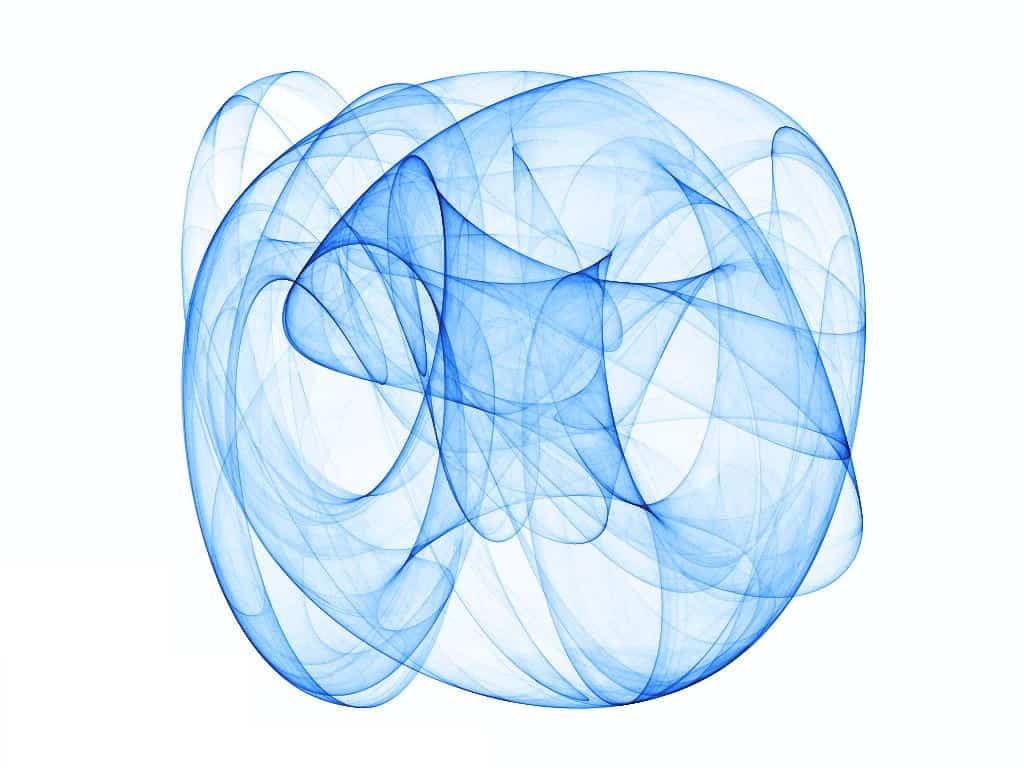
An attractor is a set of states of a dynamic physical system toward which that system tends to evolve, regardless of the starting conditions of the system.
A point attractor is an attractor consisting of a single state. For example, a marble rolling in a smooth, rounded bowl will always come to rest at the lowest point, in the bottom center of the bowl; the final state of position and motionlessness is a point attractor.
A periodic attractor is an attractor consisting of a finite or infinite set of states, where the evolution of the system results in moving cyclically through each state. The ideal orbit of a planet around a star is a periodic attractor, as are periodic oscillations. A periodic attractor is also called a limit-cycle.
A strange attractor is an attractor for which the evolution through the set of possible physical states is nonperiodic (chaotic), resulting in an evolution through a set of states defining a fractal set. Most real physical systems (including the actual orbits of planets) involve strange attractors.
The American Heritage® Science Dictionary
It has been suggested that the theory of attractors has relevance for research into seriality, synchronicity, cultural development,…….
Show some love
"A philosophical treatise can be mostly written in object or process language,
but phenomenological descriptions must be by its very nature first person descriptions.
It is for this reason that self-observations, and personal experiences of the author are included."
Marinus Jan Marijs.