Optical illusions and the mechanisms of perception
Optical illusions
Marinus Jan Marijs
An optical illusion (also called a visual illusion) is an illusion caused by the visual system and characterized by a visual percept that arguably appears to differ from reality These are not only entertaining forms of art, but optical illusions are also used in attempting to explain the underlying mechanisms of perception.
Michael Bach: “I view these phenomena as highlighting particular good adaptations of our visual system to its experience with standard viewing situations. These experiences are based on normal visual conditions, and thus under unusual contexts can lead to inappropriate interpretations of a visual scene (=“Bayesian interpretation of perception”)
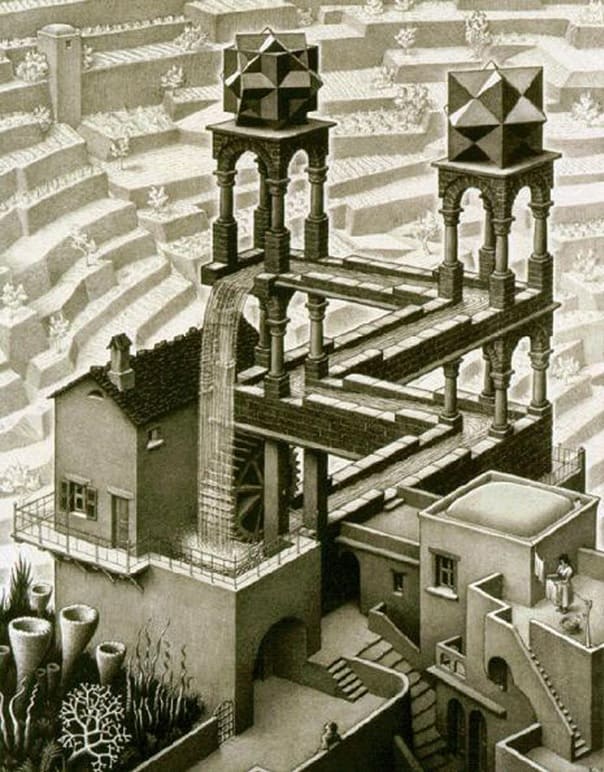 The impossible waterfall
The water path from Eschers lithograph “Waterfall” from 1961., you will see water running upwards and driving a water mill…
From Wikipedia, the free encyclopedia:
Waterfall is a lithograph by the Dutch artist M. C. Escher, first printed in October 1961. It shows a perpetual motion machine where water from the base of a waterfall appears to run downhill along the water path before reaching the top of the waterfall.
While most two-dimensional artists use relative proportions to create an illusion of depth, Escher here and elsewhere uses conflicting proportions to create a visual paradox. The watercourse supplying the waterfall (its aqueduct or leat) has the structure of two Penrose triangles. A Penrose triangle is an impossible object designed by Oscar Reutersvärd in 1934, and found independently by Roger Penrose in 1958”
This kind of optical illusion is possible because in a two dimensional representation height and depth are in fhe same direction.
Ambiguous drawings
 Rabbit Or Duck Ambigious Illusion

Ambiguous image
From Wikipedia, the free encyclopedia
“Ambiguous images or reversible figures are visual forms which create ambiguity by exploiting graphical similarities and other properties of visual system interpretation between two or more distinct image forms. These are famous for inducing the phenomenon of multistable perception. Multistable perception is the occurrence of an image being able to provide multiple, although stable, perceptions. Classic examples of this are the rabbit-duck and the Rubin vase. Ambiguous images are important to the field of psychology because they are often research tools used in experiments. There is varying evidence on whether ambiguous images can be represented mentally, but a majority of research has theorized that they cannot be properly represented mentally. The rabbit-duck image seems to be one of the earliest of this type; first published in Fliegende Blätter, a German humor magazine (Oct. 23, 1892, p. 147)”
 Verbeek’s strips could be seen differently when viewed upside down

 Man’s face / woman’s body Man’s face / woman’s body

Young woman Or old man

Young Woman or An Old Woman
This figure can be seen as a young woman or an old woman,
My Wife and My Mother-in-Law

Mouse or old man

A swan or a squirrel
A swan is on the left and a squirrel is on the right

Cat or mouse ?

Sleeping Man or Sleeping Woman

Boy – Girl

J. Botwinick “Husband and Father-in-Low “, 1961
Two faces in one

The Eskimo Indian

What’s on man’s mind ?

Edgar Allan Poe The Raven


Artush Voskanyan


Can you see the donkey? What about the seal ?


 Swans Reflecting Elephants


 Don Quijote de la Mancha. Salvador Dalí.

 Oleg Shuplyak


Abraham Lincoln
Find in the picture a wolf, a horse, a snail, a mouse, a bird, a praying man, a clown and a fish.
 Man’s face, woman’s bodies


Face gestalt front view / side view illusion
Figure-ground reversal
A visual illusion where perception alternates between two possibilities. A pair of shapes, either of which taken alone would be seen as an object of some kind, share a common border-line. What happens is that, when joined, each shape competes with the other. One is at first relegated to mere background and is hardly seen, while the other dominates as an object. Then the reverse happens: the object fades perceptually away to become for a time mere background in its turn.
from: R. Gregory, Intelligent Eye, p15-16.
 Vase Or Face
Rubin’s vase (sometimes known as the Rubin face or the figure–ground vase) is a famous set of ambiguous or bi-stable (i.e., reversing) two-dimensional forms developed around 1915 by the Danish psychologist Edgar Rubin.They were first introduced at large in Rubin’s two-volume work, the Danish-language Synsoplevede Figurer (“Visual Figures”), which was very well received; Rubin included a number of examples, such as a Maltese cross figure in black and white, but the one that became the most famous was his vase example, perhaps because the Maltese cross could also be easily interpreted as a black and white beachball.
Rubin presented in his doctoral thesis (1915) a detailed description of the visual figure-ground relationship


Necker Cube

If you look at the cube above, in all likelihood you will immediately perceive a cube in one of the two orientations as depicted below..
If you view the cube for a prolonged time, you may perceive sudden perceptual reversal (typically every 3–5 s) between the two cube orientations as depicted below. . In the Necker cube above, however, both orientations are possible.

Up – Down reversal


\

Café Wall Illusion

Are These Lines Parallel?
Despite what your eyes are telling you, they are. It is thought that the café wall illusion functions due to the high contrast in the two different “bricks.” When interpreting images, our brains tend to “spread” dark zones into light zones, a function known as irradiation; this “movement” is probably what causes a false warping effect.
Michael Bach:”Above, the tiles are moving left and right in alternating rows. In the ‘half-shifted condition’, the ‘mortar lines’; (the horizontal lines between the tiles) appear to slope alternately upward and downward. This gives the impression that the tiles are wedge-shaped. As seen when the tiles align or make up a chequerboard, the lines are actually parallel, and all tiles are perfectly square and of the same size. So during the movement, the illusion “comes and goes”.
Skye’s Oblique Grating

The blue horizontal stripes above seem oblique – but they are parallel.
 An optical illusion made of 400 tiles.
This wavy floor is actually completely flat.
This illusion is created by carefully cutting tiles, creating an illusion of forced perspective.
 Similarly, this carpet looks like it’s full of giant sinkholes.
Fraser’s Spiral

The picture depicts “Fraser’s Spiral”. But there are no spirals at all, there are a series of concentric circles.…
Source Fraser J (1908) A new visual illusion of direction. British Journal of Psychology; London 2:307–330
Impossible objects

Impossible Trident (impossible objects)
The three prongs miraculously transform into two at the end of the fork. The more you look at it, the more improbable it becomes. How does this happen?

Michael Bach:
The neighbouring contraption consists of the so-called “devil’s fork” (top right, also known as “blivet”), the “Penrose Frame” (centre) and three “hexnuts” at bottom left. Boggle your mind when trying to envisage to build such an object.
Our brain reconstructs an internal 3-dimensional world model from the flat retinal image.
 How Many Legs Does This Elephant Have?
Stare at it for a bit. You’ll figure out what’s going on here. This is a form of a cognitive illusion, called the Shepard elephant, in which our assumptions about the world are challenged in a falsified image.


Magic Faucet Fountain
How does magic faucet work?
This spectacular effect is achieved by a transparent tube in the middle of the water column that holds the tap in place and, at the same time, keeps feeding it with water pumped from below. The water goes up through the tube and exits at the top

Impossible floating Table – Tensegrity Levitation – Optical Illusion –

Infinity Cube

Mobius strip

The Möbius strip has several curious properties. A line drawn starting from the seam down the middle meets back at the seam but at the other side. If continued the line meets the starting point, and is double the length of the original strip. This single continuous curve demonstrates that the Möbius strip has only one boundary.
The Möbius strip has the mathematical property of being non-orientable. It can be realized as a ruled surface. It was discovered independently by the German mathematicians August Ferdinand Möbius and Johann Benedict Listing in 1858.

When the Möbius strip is cut with a scissors along the white line as indicated here above, the Möbius strip will not split in two halves, but will become twice as long.
Ames room illusion


Ames room illusion
How Does the Ames Room Illusion Work? The effect works by utilizing a distorted room to create the illusion of a dramatic disparity in size. … The illusion leads the viewer to believe that the two individuals are standing in the same depth of field when in reality the subject is standing much closer.
What does the Ames Room Show us about size and distance perception?
The Ames Room illusion supposedly tells us that it is essential to have adequate distance cues and proper estimate of distance from objects; otherwise we would have very strange size perception if we were fooled by a distorted room regarding the distance from the objects.
This principle has been used in the movie “The Lord of the Rings”
Inverted images
An image in which up and down, are rotated; that is, an image that results from rotating the object 180° results in a totally different image.


Sorcerer or Bad Witch
in one often-reproduced panel, Muffaroo appears in a canoe next to a tree-covered island, and is being attacked by a large fish. When inverted, the image shows a later scene of Lovekins in the beak of a giant roc: Muffaroo’s canoe has become the bird’s beak, the fish has turned into the bird’s head, the island has become its body and the trees its legs, and Muffaroo has turned into Lovekins.
Upside Down Illusion


Rotation changes the interpretation
Wife at work and at home.
One of the most popular “werewolf”-pictures – ‘Wife at work and at home”, sometimes – “Before and after the wedding”, and abroad – “Before and after six mugs of beer”. On turning the image by 180 degrees (i.e. “upside down”) the picture of a young woman turns to a portrait of an ugly old lady. An unknown artist invented and painted it as early as in the 19th century, and after that the picture was re-drawn and published several times. A modern version painted by Moscow artist L.V.Volkov is represented in the upper left corner.


Man Dog


Man Dog


Cat Dog

Two Way Face Rex Whistler Mayor And Judge


Reversible Head With Basket of Fruit (circa 1590) by Giuseppe Arcimboldo
Tilt the painting one way and it is a vibrant heap of autumnal bounty, as apples, pears, grapes, and figs puzzle for position in an alluring, if seemingly conventional, still life. Flip the oil-on-panel work on its head, as if shaking loose the fruit that fills the wicker basket, and suddenly the plumped-up portrait of a stranger assembles itself from the bright jumble of assorted sweetness. The fibrous lashes of his chestnut eye wink at you playfully to punctuate the visual joke. Painted by the 16th Century Milanese Mannerist Giuseppe Arcimboldo, who would later inspire the imaginations of 20th Century Surrealist painters, Reversible Head With Basket of Fruit tricks the eye into the restless exercise of constructing and destroying one image in favour of the other. The result is a work that is at once amusing and profound – one that reminds the observer not only of the perishability of life but how our physical existence is comprised, materially, of the fragile world around us. (Credit: Wikimedia Commons)

Circus – Clown


Frog Horse


Sailor Ship


Lenin Stalin


Mean magician
Is it a mean magician or a rabbit in a hat?

Student Professor
Gestalt Effect
 Kanizsa’s Triangle (Gestalt effect)
This shows a triangle formed by the edges of the Pac-Man yet,
The nonexistent triangle also appears to be brighter than the background, although they are of the same luminance.
This illusion, popularized by Italian psychologist Gaetano Kanizsa, reveals how we tend to seek closure in our visual perception. Some of the best optical illusions are based on the principle that our brains are trained to fill in the gaps between shapes and lines and perceive blank space as objects even when there aren’t any.
In other words, Kanizsa’s triangle is a case in point that our visual perception is shaped by experiences and not merely dependent on sensory input.
Geometric- & Angle Illusions
Zöllner Illusion

From Wikipedia, the free encyclopedia
A version of the Zöllner illusion
The Zöllner illusion is an optical illusion named after its discoverer, German astrophysicist Johann Karl Friedrich Zöllner. In 1860, Zöllner sent his discovery in a letter to physicist and scholar Johann Christian Poggendorff, editor of Annalen der Physik und Chemie, who subsequently discovered the related Poggendorff illusion in Zöllner’s original drawing.[1][2]
One depiction of the illusion consists of a series of parallel, black diagonal lines which are crossed with short, repeating lines, the direction of the crossing lines alternating between horizontal and vertical. This creates the illusion that the black lines are not parallel. The shorter lines are on an angle to the longer lines, and this angle helps to create the impression that one end of the longer lines is nearer to the viewer than the other end. This is similar to the way the Wundt illusion appears. It may be that the Zöllner illusion is caused by this impression of depth.
This illusion is similar to the Hering illusion, the Poggendorff illusion and the Müller-Lyer illusion. All these illusions demonstrate how lines can seem to be distorted by their background
Hering Illusion

The standard Hering illusion (1861).
The Hering Illusion is one among a number of illusions where a central aspect of a simple line image – e.g. the length, straightness, or parallelism of lines – appears distorted by other aspects of the image – e.g. other background/foreground lines, or other intersecting shapes.
Ponzo illusion

The Ponzo illusion is an optical illusion that was first demonstrated by the Italian psychologist Mario Ponzo (1882-1960) in 1913. He suggested that the human mind judges an object’s size based on its background. He showed this by drawing two identical lines across a pair of converging lines, similar to railway tracks.

Ponzo Illusion

Ponzo Lines Illusion

Which of the red lines is longer? The red lines in the picture are equal!
Müller-Lyer Illusion

Both central lines are of the same length
Parallelogram Illusion

Segments
The length of A and B segments is equal, although it looks different by sight.
Poggendorff Illusion
\
The Poggendorff Illusion (geometric)
In the image at top left you see the basic effect: the two ends of a straight line segment passing behind an obscuring rectangle appear offset when, in fact, they are aligned. Place your mouse pointer over the image (or tap it) to convince you of this.
On the right is a variation where the width of the occluding rectangles can be varied or they can be made partially transparent. I selected the starting value of the rectangle width so that the oblique lines appeared offset by nearly half of their distance.
This illusion was discovered in 1860 by physicist and scholar JC Poggendorff, editor of Annalen der Physik und Chemie, after receiving a letter from astronomer F. Zöllner. In his letter, Zöllner described anlusion he noticed on a fabric design in which parallel lines intersected by a pattern of short diagonal lines appear to diverge (Zöllner’s illusion). Whilst pondering this illusion, Poggendorff noticed and described another illusion resulting from the apparent misalignment of a diagonal line; an illusion which today bears his name.
Named after Johann Poggendorff, a German physicist who first described this illusion in 1860, the Poggendorff illusion reveals how our brains perceive depths and geometric shapes, but the cause of this optical illusion has not yet been adequately explained.
Although so far no theories have satisfactorily explained this visual error, the prevailing belief is that our brain attempts to interpret a 2D image with 3D properties and distorts the depth between lines.
 A rectangle in perspective Both rectangles have equal shape and sizes
T-llusion

The vertical line is percived as a longer one.
The vertical part of the inverted ‘T’ (right) changes its length. Click on it, the movement will stop, and you can now drag the size until you are satisfied that the vertical and horizontal parts are identical in length. Then pressing the “Show result” button, the length in percent is displayed and the veridical length is overlaid in green.

Top hat illusion” (Wundt-Fick variant)
Also known as the “Oppel-Kundt illusion”. A nice variant on:the thin dashed lines, indicating height & width of the top hat, indeed span identical distance.
The Yastrov illusion

Which of the figures is larger? They are absolutely equal.
The Jastrow illusion is an optical illusion attributed to the Polish-American psychologist Joseph Jastrow. This optical illusion is known under different names: Ring-Segment illusion, Jastrow illusion, Wundt area illusion or Wundt-Jastrow illusion.
There are several competing explanations of why the brain perceives the difference in size between the ring segments, none of which has been accepted as definitive.
One explanation relates to how the mind interprets the two-dimensional images on the retina as a three-dimensional world. Another explanation relates to the fact that the mind can only attend to a small field of vision, which is reconstructed by our consciousness. The most commonly used explanation is that the brain is confused by the difference in size between the large and the small radius. The short side makes the long side appear longer, and the long side makes the short side appear even shorter.
Irradiation phenomenon

Which of the internal squares is bigger? Black or white? Irradiation phenomenon lies in the fact that light objects on the dark background seem bigger compared to their real size and as if occupy some part of dark background. When we view light surface against dark background, the borders of this surface as if widen due to imperfection of the lens, and this surface seems to us bigger, than its genuine geometric size. Due to colors brightness the white square seems much bigger compared to the black square on the white background. It is interesting to note that being aware of this feature of black color to make the size smaller, duelists of the 19th century preferred shooting in black suits expecting that the opponent would miss at shooting.
Staircase


- C. Escher published in 1960 his well-known lithography “Ascending, descending” (on the right). Its design was based on a figure (bottom left) in the paper published by the Penroses’ in 1958, and there was a letter exchange between them.
Source
Penrose LS & Penrose R (1958) Impossible objects: A special type of illusion. Brit J Psychol 49:31-33


Luminance & Contrast illusion
Adelson’s checker shadow illusion
Checker Shadow Illusion (contrast)

In this famous visual illusion, the square marked with an A looks a lot darker than B, right? But in reality, they are the same shade of grey. If you don’t believe in me, click on this link to see the proof.

The central field and the upper blabk field have the same grey-tone.
Adelson’s checker shadow illusion is a classic example of how our visual system does not perceive in absolute terms. Here the situation for visual interpretation on the checkerboard is complex: There is light coming onto the surface, then there’s the shadow cast by the cylinder, and both light and dark squares under the shadow.
There are several variables involved in how the brain determines the colors of squares A and B, as explained by Adelson, using past experiences with contrast and shadows as a reference point. Here, the proximity of light and dark squares as well as soft shadows fools the brain into making the wrong judgments.
But for Adelson, this illusion is proof of our visual system’s effectiveness, rather than its defectiveness, in that it successfully constructs meaning by breaking down visual information.
White’s illusion
Despite what you may think, the gray rectangles under columns A and B are the exact same color.

This discovered in 1979 by Australian psychologist Michael White, this famous effect is known as White’s illusion. Since then, researchers have proposed several theories to explain the cause of this illusion — you can read about them here.
White’s illusion is a brightness illusion where certain stripes of a black and white grating is partially replaced by a gray rectangle (Fig. 1). Both of the gray bars of A and B are the same color and opacity.

Simultaneous contrast illusion. The background is a color gradient and progresses from dark gray to light gray. The horizontal bar appears to progress from light grey to dark grey, but is in fact just one color.
Space, 3D & Size Constancy

Shepard’s Tables (size)
When you look at the two tables above, do they appear very different in size and shape? Would you believe that the two tabletops are exactly the same? If not, check out this animated illustration to see for yourself.
First presented by American psychologist Roger Shepard in his book Mind Sights (1990), this simple yet astonishing visual illusion is further proof that our vision system is largely influenced by our experiences with the outside world and therefore interferes with reality sometimes.
In this illusion, the perceptual error was caused by the fact that our brain couldn’t help but make a 3D interpretation of the 2D pictures, and perceive very different sizes because of perspective foreshortening: The closer the object is in distance, the larger it is on our retina.
Michael Bach:
The two table tops certainly do not look alike!
This phenomenon plays on the interchange of 2- and 3-dimensional interpretation of the figure. In the real-world scene, the tables certainly have a different shape. In that sense this not really an illusion, rather a “trick” by intermingling image space (the 2-dimensional screen in front of you) and object space (the “real” tables). It certainly reveals that our brain can appropriately deduct 3-d object properties from 2-d drawing

“Shepard’s tables” deconstructed. The two tabletops appear to be different, but they are the same size and shape.
The Delboeuf Illusion

Though the two circled dark discs are the same size, the left disc seems smaller than the right one.
Ebbinghaus Illusion

The two orange circles are exactly the same size; however, the one on the right appears larger.
Origami
“Where is the fifth pig?” (1940) Anti-Nazi puzzle created in occupied Holland
 You are given a picture of 4 pigs. You are supposed to find the 5th pig which is also shown with the 4 pigs on the same page.
https://www.youtube.com/watch?v=J9Zfml7qqVA
If you like Origami you can print thus puzzle here below:


Face Text

Kinetic art
Gives the suggestion of movement.
Transformations


Close – Distant Illusions

The painting “All is Vanity” by Charles Allen Gillbert (1873–1929).
The figure can be seen as a woman looking at her reflection in a mirror, or a skull


Octavio Ocampo

Octavio Ocampo Do You See an Elderly Man and Woman or a Young Man and Woman?


2D – 3D transformation


Drawing Hands (1948) by MC Escher
Used effectively, an optical illusion momentarily forces the observer to rethink the relationship between the real world that he or she inhabits and the one depicted in the work. No one understood the penetrative power of illusion better than the Dutch graphic artist MC Escher. In his mesmerisingly meta Drawing Hands (1948), Escher magics from the work’s sketchy surface a closed-circuitry of the-hand-creating-the-hand-creating which appear to defy the limitations of two-dimensional drawing. Obsessed with the mathematics of repeating patterns, Escher’s work was admired by leading contemporary physicists and philosophers. In Drawing Hands, the graphite point of the mirroring pencil appears to be the teensy conduit through which the artist’s existence simultaneously flows into being and dissolves into nothingness. Caught in Escher’s endless rotation, the viewer’s eye is left to run circles around itself. (Credit: public domain)

 Pere Borrell (1874).
Fractal structures


Convex – Concave

A simple illustration reveals how the brain perceives shading to create a three-dimensional world
The left shape is seen as hollow, and the right shape is seen as convex, because light usually shines from above.


Show some love
"A philosophical treatise can be mostly written in object or process language,
but phenomenological descriptions must be by its very nature first person descriptions.
It is for this reason that self-observations, and personal experiences of the author are included."
Marinus Jan Marijs.